

Vivo X500 Pro Max Review
-
Design and Build Quality
-
Display
-
Battery Life and Charging
-
Cameras
-
Software and Performance
-
Pricing/Value
A Truly Complete Flagship Experience
The Vivo X500 Pro Max stands out as a highly complete flagship smartphone, offering abundant performance, an impressive camera system with versatile accessories, and a stunning display. Its robust battery life and rapid charging further enhance its appeal. While its premium price is a consideration, it delivers exceptional features and a polished user experience, making it a strong contender in the high-end market.
Advantages
- Stunning 6.85-inch LTPO AMOLED display (144Hz, 4400 nits peak brightness)
- Excellent design and build quality with IP68/IP69 certification
- Powerful MediaTek Dimensity 9600 Pro (2nm) processor delivers top-tier performance
- Impressive and versatile camera system (200MP telephoto, 50MP main with LOFIC, 8K video)
- Outstanding battery life (6750 mAh, up to two days)
- Very fast 90W wired and 40W wireless charging
- Clean, customizable, and responsive OriginOS 7 software
- Effective and innovative photography accessories (teleconverters, grip)
- Accurate ultrasonic in-display fingerprint reader
- Stable on flat surfaces despite prominent camera island
Disadvantages
- High premium price point
- Top speaker noticeably quieter than the bottom one
- Unsightlying certification labels on the side of the frame
- Front camera facial cutout in portrait mode could be improved
- Ultrawide night shots in default mode can sometimes be less detailed than main camera
- Grip accessory is less practical for vertical photography
- No 16GB RAM option in the top-tier version tested
Contents
Vivo X500 Pro Max Review: A Comprehensive Look
Android smartphone manufacturers are increasingly venturing into the ‘Pro Max’ segment, a naming convention often associated with premium devices. The question arises: does such branding guarantee a robust, high-end product? This review of the Vivo X500 Pro Max scrutinizes the brand’s latest offering, evaluating its photographic capabilities and the power of its 2nm MediaTek processor.
What’s in the Box?
The Vivo X500 Pro Max was provided for testing in China prior to its Shanghai launch. While the packaging and contents of this test unit may differ slightly from the European retail version, the initial presentation is noteworthy. The box is slim, reminiscent of those used for foldable phones like the HONOR Magic V6.
Inside, the contents are fairly standard. The smartphone itself occupies the top layer. Below, two smaller boxes are nestled. The left box contains a SIM tray ejector tool, documentation, and a soft silicone case. This case is well-fitted, matching the phone’s color, and offers protection for both the screen and the camera island. The second, larger box houses only a USB Type-A to USB Type-C cable.
For this review, an extensive photography kit was also provided. It included a special modular plastic case designed to accommodate aluminum overlays. One overlay protects the camera island, while another provides a 67mm thread for attaching filters. A third allows for the installation of teleconverters. The Vivo X500 Pro Max is compatible with both 200mm and 400mm teleconverters, both of which were included, complete with tripod mounts. Complementing this comprehensive setup was a grip featuring comfortable buttons and a built-in 2300 mAh battery, along with a strap from PGYTECH.
Design and Build Quality of the Vivo X500 Pro Max
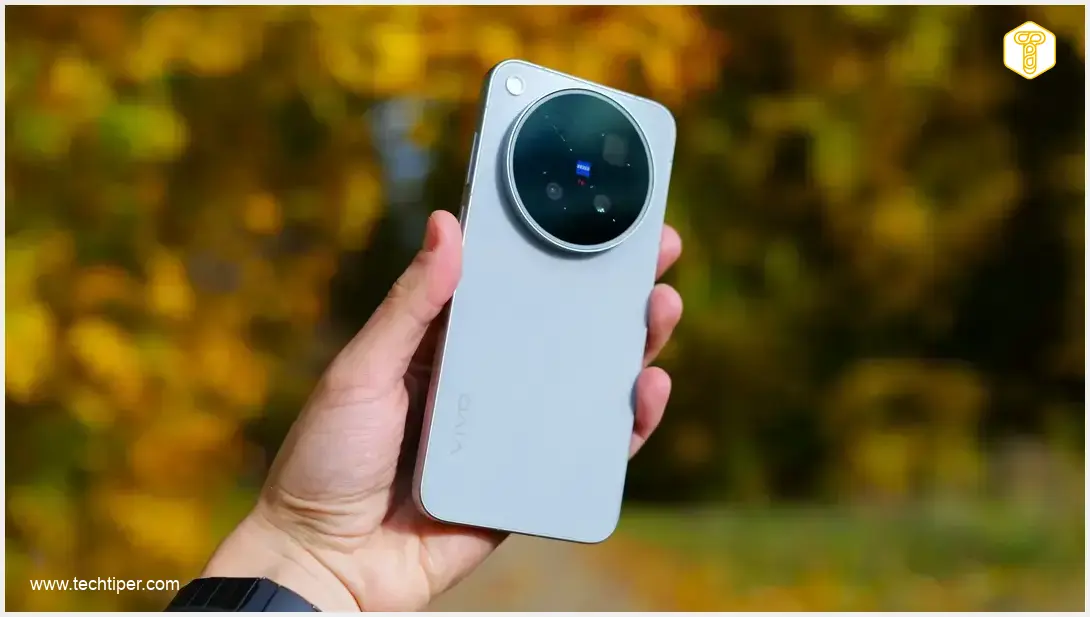
During its Chinese launch, the device was showcased in three color variants. The orange version is unlikely to be released in Europe. The review unit features a sophisticated grey finish, which, in my opinion, is the most attractive in the Vivo X500 series. While press materials may not fully capture its appeal, the grey version truly shines in person, revealing various textures on its glass surface.
The lower section is predominantly matte, contrasted by the glossy manufacturer’s logo and irregular, star-like speckles. Around the camera island, a dense dot pattern is applied, also featuring the shiny points seen on the lower part. This textural change is noticeable to the touch, with the glass near the camera island feeling distinctly thicker. Furthermore, the color isn’t simply grey; in good lighting, it subtly shifts into a delicate blue hue. The camera island’s shape resembles that of the Vivo X300 Ultra, but it protrudes significantly less, resulting in better balance for the smartphone compared to its ultra-flagship predecessor. A ZEISS logo is centrally placed between the lenses, adding to the intricate design of the rear, which I consider one of the most aesthetically pleasing among current smartphones.
The phone boasts a sealed construction, evidenced by its IP68 and IP69 certifications, indicating excellent dust and water resistance. Despite the prominent camera island, its central placement ensures the Vivo X500 Pro Max remains remarkably stable on flat surfaces. The frame, crafted from aluminum, features pleasantly rounded edges. The top edge of the device houses only a speaker grille. On the left side, an additional customizable button is present. However, the unsightly and intrusive certification labels and model information on this side are a minor aesthetic drawback, as other manufacturers, such as Google Pixel, manage to integrate such markings more discreetly.

The right side is standard, featuring the volume buttons and the power/lock key. The bottom houses the SIM card tray, a charging and data transfer port, a microphone opening, and another speaker grille. The speakers deliver a stereo effect, though the top speaker is noticeably quieter than the main bottom one. The sound quality is decent, offering a reasonable soundstage and even some low-frequency tones. However, similar to my experience with the foldable Vivo X Fold6, I found the maximum volume to be somewhat lacking compared to flagships from brands like HUAWEI or Google, which offer a more robust audio output.
The front of the device is mostly covered by a flat sheet of hardened glass. As expected for a flagship, the bezels are minimal, giving the X500 Pro Max a contemporary look. A narrow earpiece cutout is located at the top edge, with the front camera positioned beneath it. An ultrasonic fingerprint reader is integrated under the display, offering convenient placement and precise operation.
Display
The Vivo X500 Pro Max is the largest model in the X500 series, featuring a generous 6.85-inch LTPO AMOLED panel. This display boasts a high resolution of 1440 × 3168 pixels, resulting in an impressive pixel density of 507 ppi. With a refresh rate of up to 144 Hz, it’s particularly appealing to gamers.
The display’s image parameters are excellent. Blacks are deep, colors are vividly saturated, and the panel offers comfortable viewing even at sharp angles. Consuming content and gaming on the Vivo X500 Pro Max is a very enjoyable experience. The panel also excels for photography, with a peak brightness of up to 4400 nits ensuring high readability of displayed content. Even on a sunny day, with direct sunlight, I had no issues framing and capturing shots.
Battery Life and Charging
The Vivo X500 Pro Max (European variant) comes equipped with a robust 6750 mAh battery. While it doesn’t quite match devices with the largest cells, such as the Xiaomi Redmi Note 17 Pro Max (which has approximately 2460 mAh more), its capacity surpasses that of most flagships currently available in the market.
This translates into comfortable endurance on a single charge. The smartphone consistently delivered a full day of use under heavy load without issues. With typical usage, the Vivo X500 Pro Max can last for about two days, comparable to the OPPO Find X9 Ultra and OnePlus 15. This model notably outperforms flagships from HUAWEI or the Pixel 11 Pro XL in terms of battery longevity.
The Vivo X500 Pro Max supports a maximum charging power of 90 watts. I typically connected the device to the charger when the battery was at 2%. After just 15 minutes, the phone reached 31% charge, recovering approximately 1960 mAh. It took precisely 25 minutes to reach the first 50%. A full charge was achieved in 56 minutes. This charging speed is very impressive. Furthermore, the device supports wireless charging at up to 40 watts.
Cameras
While the Vivo X300 Ultra remains the most camera-centric model in Vivo’s lineup, the X500 Pro Max also features a sizable camera island, sharing some similarities with the X300 Ultra. Notably, the telephoto lens is a near-identical twin: a 200MP unit with a 1/1.4-inch sensor (f/2.7, PDAF, OIS), offering an 85mm equivalent focal length for approximately 3.5x optical zoom. This unit is paired with an advanced stabilization system rated at CIPA 7.0, indicating exceptional shake reduction.
Users also benefit from a 50MP main camera featuring a Sony Lytia 910 sensor (f/1.6, 24mm, PDAF, OIS). This unit incorporates LOFIC technology, allowing it to capture significantly more light within the frame. The ultrawide-angle camera also boasts 50MP, with an f/2.0 aperture and a 15mm equivalent focal length for full-frame capture.
The camera application is excellent, offering a wealth of photo and video modes, many of which can be enhanced with interesting color styles. I particularly enjoyed the film simulations, and each predefined color profile can be further customized. However, users might need some time to get accustomed to the layout, as accessing certain settings, like longer exposure times, requires several taps.
Photo Quality
It comes as no surprise that daytime photos are stunning. Using the default “Natural” color profile with the ZEISS logo and the basic photo mode, every lens reproduced natural colors, pleasant contrast, and abundant detail. Shots of architecture, for instance, demonstrate the main camera’s excellent handling of highlights. The telephoto lens’s focal length is also superb; a 3.5x zoom (85mm) proves more practical than, for example, the 5x zoom found on some competitors.
The telephoto lens offers a relatively moderate zoom, but its large sensor and high resolution provide significant flexibility. As a result, with the aid of effective algorithms and without additional lenses, it’s possible to capture very good 10x zoom photos. Even 20x and 30x digital zoom shots can look impressive.
Similar to the Google Pixel 11 Pro XL, the Vivo X500 Pro Max captures night photos incredibly quickly, often without needing to extend exposure times. This can sometimes affect ultrawide-angle shots. In default photo mode, results are generally not as good as those from the HUAWEI Pura 90s Pro Max, which consistently uses longer exposures in low light. For challenging conditions, I recommend using the “Landscape and Night” mode, which dramatically pulls out detail from shadows.
How do other night shots look using the default mode? The main camera is reliable in all conditions, capable of producing phenomenal images. The telephoto lens performs almost as well. Even photos taken with 10x digital zoom are suitable for social media sharing.
The front-facing camera is decent. In daylight, it performs adequately, although facial cutout in portrait mode could be improved. At night, the smartphone defaults to longer exposure times, resulting in brighter photos, but reflections in glasses can sometimes detract from the selfie’s overall appeal.
The smartphone records video at a maximum resolution of 8K at 30 frames per second, or an impressive 4K at 240 frames per second. Additionally, it supports a 10-bit flat log color profile, accessible directly from the default video mode, with even greater control offered in Pro video mode. I particularly appreciate that the advanced video mode allows for not only multiples of 30 FPS but also 24, 25, 50, and 100 frames per second.
The quality of recorded videos is excellent, though the Pro video mode allows for the most creative control. I used the Vivo X500 Pro Max to capture many B-roll shots for reels at a recent motor show in Paris. Even with default settings, the quality remains very good, with impressive detail, efficient autofocus, and effective stabilization that minimizes shakes.
Photography Accessories
The additional accessories significantly enhance the photographic experience. The strap with its quick-release mechanism is practical, as is the grip. The buttons and dials on the grip function surprisingly well, and its built-in 2300 mAh battery extends shooting sessions. However, this accessory is primarily useful for horizontal photography; for vertical shots, the grip can be more of a hindrance than a help.
The teleconverters, of course, make the biggest difference. The smaller one is much handier, lighter (approximately 161 grams), and doesn’t significantly alter the phone’s center of gravity. However, the 200mm focal length doesn’t offer a dramatic “wow” effect. The 400mm lens is considerably less portable, but the results are worth carrying the extra 260 grams.
Photos taken with the teleconverters are best in daylight, but even after dark, experimenting with them can yield good results. I managed to capture some interesting shots with the test smartphone and the additional lens.
Software and Performance
Upon unboxing, the tested smartphone is expected to run Android 17 with the highly capable OriginOS 7 overlay. Visually and to some extent functionally, the software bears a resemblance to iOS, yet it offers the impressive customization options characteristic of the Android ecosystem. Beyond simple changes to wallpaper, grid size, or icons, users can select an interactive AI cat for the lock screen, indicating almost limitless personalization potential.
The device is free from excessive third-party bloatware and unnecessary Vivo applications, resulting in a clean interface upon initial boot-up. Artificial intelligence primarily features in the photo editor and Google’s Gemini solutions. Personally, I don’t find this an issue, as the system isn’t overloaded.
The features of OriginOS 7 are excellent. I particularly appreciate the Origin Island, which functions and looks much like Apple’s Dynamic Island. The additional customizable button is also a great inclusion, and the gaming overlay works effectively, as do virtually all of the manufacturer’s enhancements. I have been using the smartphone daily for nearly a month and have encountered no irritating flaws or bugs in the interface.
The Vivo X500 Pro Max is one of the first smartphones on the market to feature the MediaTek Dimensity 9600 Pro processor, manufactured using 2nm technology. This integrated chip is fantastic. While I haven’t had the opportunity to test the latest Snapdragon Elite, the Dimensity 9600 Pro offers more power than last year’s 8 Elite Gen 5. No game, however demanding, poses a challenge for the X500 Pro Max. Applications launch instantly, and the interface itself is incredibly responsive. The CPU and GPU power are impressive. The device also performs well in AI computations, though it’s a minor drawback that the top-tier version doesn’t include 16GB of RAM, as the tested unit features 12GB of RAM alongside a generous 1TB of storage.
Tests were conducted on the latest pre-release software. It’s possible that in the coming weeks, the Vivo X500 Pro Max may achieve slightly better benchmark results (especially in Geekbench and AITuTu). However, there’s little to complain about, as the X500 Pro Max achieved a record-breaking score in AnTuTu.
Temperatures during everyday use are not problematic. When browsing social media and the web, the device remains pleasantly cool. Under heavy load, it becomes warm, and after a prolonged period, even hot. However, this is a phenomenon observed with every smartphone featuring a flagship processor. After a 10-minute stress test in AnTuTu, the Vivo X500 Pro Max’s casing reached 42.5 degrees Celsius (108.5 degrees Fahrenheit) at its hottest point.
Technical Specifications and Pricing
The Vivo X500 Pro Max is not an inexpensive smartphone. The 12GB RAM/256GB storage variant is expected to launch at a premium price point. A larger 12GB RAM/512GB storage version would be even more costly, with a 1TB variant likely not offered in all markets. Opting for the device bundled with the 400mm teleconverter significantly increases the investment, initially offered at a special launch price, but expected to settle at an even higher retail price in the future. The device is priced at a premium level, with variations depending on storage configurations and bundled accessories.
Key Specifications:
- System: Android 17 (OriginOS 7)
- Display: 6.85-inch LTPO AMOLED, 1440 × 3168 pixels, 507 ppi, up to 4400 nits peak brightness, 144 Hz refresh rate
- Processor: MediaTek Dimensity 9600 Pro (2nm)
- RAM: 12 GB RAM
- Internal Storage: 256 GB, 512 GB, or 1 TB
- Cameras:
- Rear: 50 MP (f/1.6, 24mm, PDAF, OIS) main, 50 MP (f/2.0, 15mm ultrawide), 200 MP (f/2.7, 85mm telephoto, PDAF, OIS)
- Front: 50 MP (f/2.0)
- Connectivity: 5G + Wi-Fi 7 + Bluetooth 6.0
- Other Features: In-display fingerprint reader, IP68/IP69 certification, stereo speakers
- Battery: 6750 mAh, 90W wired charging, 40W wireless charging
- Dimensions: 163.3 × 76.8 × 8.1 mm
- Weight: 225 g
Conclusion and Our Opinion
After nearly a month of testing, I can confidently state that the Vivo X500 Pro Max is the most complete flagship (not an ultra-flagship) I’ve had the pleasure of using. Currently, its only potential rival is the OPPO Find X10 Pro Max, which I have not yet had the opportunity to test.
Almost everything about its construction is right. Performance is abundant, the cameras impress in all conditions, and the screen delivers excellent parameters and visibility even in bright sunlight. I also positively rate the system and the device’s aesthetics. The battery life and charging speed are commendable. The primary concern for this flagship Vivo device is its high price, which approaches that of this year’s X300 Ultra. However, if you are seeking a comprehensive Android smartphone with the best possible features, the Pro Max model comes highly recommended.
Frequently Asked Questions (FAQ)
The “Pro Max” designation typically implies a top-tier device within a manufacturer’s lineup, offering the largest display, most advanced camera system, and cutting-edge performance. The Vivo X500 Pro Max lives up to this by featuring a large 6.85-inch 144Hz AMOLED display, a versatile triple camera setup including a 200MP telephoto lens and 50MP main sensor with advanced stabilization, and a powerful MediaTek Dimensity 9600 Pro processor.
The Vivo X500 Pro Max boasts an impressive camera system with a 200MP telephoto lens (3.5x optical zoom), a 50MP main sensor with LOFIC technology for enhanced light capture, and a 50MP ultrawide lens, all co-engineered with ZEISS. Its photo quality is excellent in daylight, and while its default night mode is fast, dedicated night modes perform very well. It supports 8K/30fps and 4K/240fps video recording with a 10-bit log profile, offering great flexibility for professional use. The optional photography accessories further enhance its capabilities, especially the teleconverters.
Equipped with a substantial 6750 mAh battery, the Vivo X500 Pro Max offers excellent battery life. Under heavy usage, it can comfortably last a full day, and with typical usage, it can extend to approximately two days on a single charge. It also supports rapid 90W wired charging, achieving a full charge in under an hour, and 40W wireless charging for added convenience.
Absolutely. Powered by the 2nm MediaTek Dimensity 9600 Pro processor, the Vivo X500 Pro Max delivers exceptional performance. It handles even the most demanding games and applications with ease, offering instant app launches and a highly responsive interface. Its CPU and GPU power are impressive, making it an ideal choice for users who require top-tier performance for gaming, multitasking, and resource-intensive tasks.
Source: Own elaboration. Opening photo: Krzysztof Wilamowski
About Post Author
