

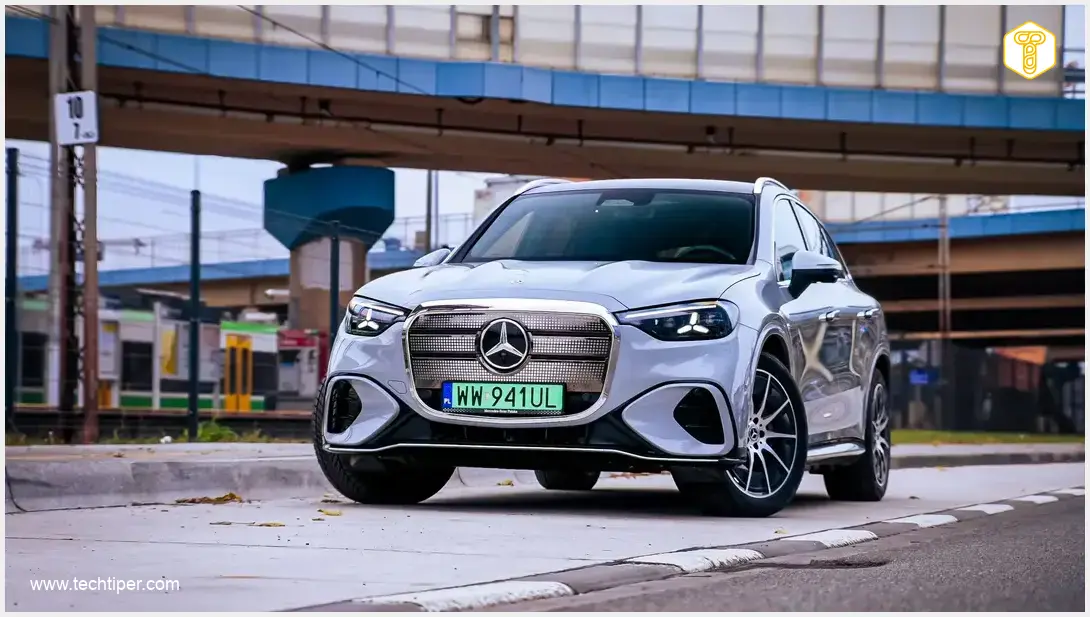
Mercedes GLC 400 4MATIC EQ Review
-
Comfort
-
Performance
-
Technology & Multimedia
-
Interior Quality & Luxury
-
Range & Charging
-
Driving Dynamics
-
Assistance Systems (ADAS)
Mercedes GLC 400 4MATIC EQ: A Benchmark for Electric Luxury
The Mercedes GLC 400 electric significantly benefits from Mercedes’ learnings, offering benchmark practicality and unrivaled comfort, especially with the optional air suspension and rear-axle steering. Its integration of modern technologies, impressive performance, and high-quality interior make it a top-tier luxury EV. While it boasts ultra-fast charging and advanced assistance systems, it faces minor challenges in optimal energy management compared to some competitors, and some key features like 400V charging compatibility are optional extras.
Advantages
- Unrivaled comfort, especially with air suspension and rear-axle steering.
- Powerful performance (489 hp, 0-100 km/h in 4.3s).
- Sophisticated and expansive MBUX Hyperscreen technology with Google integration.
- High-quality interior materials and impeccable fit and finish.
- Ultra-fast DC charging (up to 330 kW) and V2L/V2H capabilities.
- Generous interior space and practical frunk/trunk capacity.
- Top-tier advanced driver-assistance systems (ADAS) and excellent lighting.
Disadvantages
- Real-world range often less than WLTP, especially in cold temperatures.
- 400V charging compatibility is an optional extra, not standard.
- Extensive ambient lighting can be distracting and cause reflections.
- Mirrors considered too small for a large SUV, impacting visibility.
- Energy consumption, while improved, is not class-leading.
- High price, significantly increased with optional equipment.
Contents
Mercedes GLC 400 4MATIC EQ Review: Power, Luxury, and a Surprise on Wheels
The automotive landscape is rapidly shifting towards electrification, and Mercedes-Benz is at the forefront with models like the GLC 400 4MATIC EQ. This particular variant signifies a fully electric vehicle, promising a robust 489 horsepower, rapid charging capabilities, and an impressive estimated range of up to 634 kilometers (394 miles). While we put these claims to the test in real-world scenarios, one feature stood out immediately: the combination of air suspension with rear-axle steering. This pairing transforms the driving experience, delivering unexpected levels of comfort and agility.
For those accustomed to traditional automotive interiors, the GLC 400 EQ’s cabin might require some adjustment due to its modern, screen-heavy design. However, there’s no denying its status as an incredibly comfortable and remarkably swift vehicle. This review delves into every aspect, exploring its numerous advantages and any potential drawbacks to provide a comprehensive understanding of what the Mercedes GLC 400 EQ offers.
Pricing, Trims, and Warranty for the Mercedes GLC EQ
The third-generation Mercedes GLC, in its fully electric iteration, marks a significant step for the brand. While internal combustion engine (ICE) versions are still current, our focus here is on the electric variants, which are available in several power configurations:
- GLC 250 Electric: Rear-wheel drive, 354 horsepower, 85 kWh battery.
- GLC 300 4MATIC Electric: All-wheel drive, 421 horsepower, 85 kWh battery.
- GLC 400 4MATIC Electric: All-wheel drive, 489 horsepower, 94 kWh battery.
Mercedes has streamlined its powertrain offerings, with the most powerful GLC 400 4MATIC Electric being exclusively paired with a larger battery. It’s anticipated that more combinations will become available over time, expanding choices for consumers.
The GLC EQ comes with a comprehensive warranty package: a 2-year, unlimited-mileage factory warranty for the entire vehicle, a 3-year paint warranty, and a 12-year perforation warranty. The high-voltage traction battery is covered by an 8-year or 160,000-kilometer (100,000-mile) warranty, ensuring long-term peace of mind. Additional service packages are also available for further coverage.
The tested Mercedes GLC 400 4MATIC EQ is the top-tier, most powerful, and initially most expensive variant. Being a premium segment vehicle, its final price significantly increases with optional equipment. Our review model included substantial upgrades:
- Premium Plus Package with Digital Extras: Panoramic roof, Burmester 4D sound system, MBUX Hyperscreen, heated rear seats, enhanced ambient lighting, keyless entry, flush door handles, advanced Digital Light headlights with projection function.
- AMG Line: Exterior and interior styling enhancements.
- Agility & Comfort Package: Air suspension and rear-axle steering.
- Manufaktur Paint: Solid Alpine Grey.
- Leather Upholstery: Black with blue stitching.
- MB.DRIVE ASSIST (Digital Extra): Advanced adaptive cruise control.
- Tow Hitch with ESP System.
- Head-up Display with MBUX Augmented Reality Navigation.
- Sports Seats Package (AMG).
- MB.DRIVE PARKING ASSIST 360 (Digital Extra): 360-degree cameras.
- DC Fast Charging System (400V compatibility).
- AC On-board Charger (22 kW).
- Winter Package: Heated steering wheel and wiper blades.
With these options, the total price of the tested GLC electric approached the top of its range, reflecting a nearly fully loaded configuration. It’s important to note that many “Digital Extras” are subscription-based features, often active for a limited period (e.g., 3 years), and can be activated at any time, even after vehicle purchase.

Technical Specifications of the Mercedes GLC 400 4MATIC EQ
The Mercedes GLC 400 4MATIC EQ is equipped with a 94 kWh battery (usable capacity) and two electric motors, one on each axle, delivering a combined output of 489 horsepower and 800 Nm (590 lb-ft) of torque. This powerful setup allows the approximately 2.5-metric-ton (5,500-pound) SUV to accelerate from 0 to 100 km/h (0-62 mph) in a mere 4.3 seconds, which are impressive figures for its class.
A key technical advantage is its 800V architecture, enabling ultra-fast charging at up to 330 kW. However, a crucial point for buyers is that the GLC does not toyota-corolla-cross-gr-sport-test-a-facelift-responding-to-customer-needs/ standardly accept power from 400V charging stations. An optional extra in the configurator is essential for compatibility with prevalent 400V charging infrastructure in many regions.
The electric GLC is noticeably larger than its internal combustion engine counterpart, measuring 4845 mm (190.7 inches) in length, 1913 mm (75.3 inches) in width (2089 mm or 82.2 inches with mirrors), and 1644 mm (64.7 inches) in height, with a wheelbase of 2972 mm (117 inches). This represents an increase of nearly 13 cm (5 inches) in length and almost 9 cm (3.5 inches) in wheelbase compared to the current ICE GLC model.
These dimensions translate directly into enhanced practicality: the rear trunk offers a generous 570 liters (20.1 cubic feet) of cargo space, expanding to 1740 liters (61.4 cubic feet) with the rear seats folded. Additionally, a convenient 128-liter (4.5 cubic feet) front trunk, or “frunk,” provides extra storage. The extended wheelbase also significantly increases rear-seat legroom, demonstrating that Mercedes designed this vehicle from the ground up as an electric model, maximizing interior volume and utility.
A Brief History of the Mercedes GLC
When considering the Mercedes GLC, many recall the popular internal combustion engine model, first launched in 2015 (X253). Its second generation, introduced in 2022, is available in both SUV (X254) and Coupe (C254) body styles. These models remain current in showrooms, even though the GLC 400 EQ (X540) is fundamentally a distinct vehicle.
Mercedes has recently moved away from its standalone “EQ” electric sub-brand, integrating electric vehicles directly into existing model lines with designations like “electric” or “EQ technology.” As such, the direct predecessor to the GLC EQ was the EQC, which had a relatively short production run from 2019 to 2023. The GLC EQ itself debuted in 2026.
Strictly speaking, the GLC EQ should be viewed not merely as another GLC variant, but as a vehicle built on entirely new electric technology, sharing little more than its name with its ICE brethren. However, it is expected that future refreshes of the GLC line will streamline this naming convention. This approach mirrors the CLA, where an electric version was introduced before an almost identical internal combustion model. In the premium D-segment SUV market, the Mercedes GLC EQ competes directly with rivals such as the BMW iX3, Audi Q6 e-tron, Volvo EX60, and Lexus RZ, with the Tesla Model Y also often considered a competitor.
The Mercedes GLC EQ’s Multimedia System: A Deeper Dive
Mercedes-Benz has consistently pushed boundaries with its in-car software, and the GLC EQ features the latest evolution of MB.OS. This comprehensive platform integrates all vehicle modules, not just multimedia, allowing for extensive over-the-air updates. While initially overwhelming, the logical layout of shortcuts and functions quickly becomes intuitive. Existing Mercedes users will find the interface familiar, maintaining a similar layout and logic.
Crucially, while Mercedes doesn’t use Android Automotive OS directly, its platform supports third-party applications designed for Google’s ecosystem, integrating numerous services from the American tech giant. Performance is excellent, with no noticeable lag or responsiveness issues.
Mercedes has embraced multiple displays in the GLC electric. Even in its standard configuration (MBUX Superscreen), drivers are treated to:
- A 10.3-inch digital instrument cluster.
- A 14-inch central display.
- A 14-inch passenger display.
Our review model featured the MBUX Hyperscreen, which visually unifies these panels into a single, expansive 39.1-inch display. Though still an LCD, it boasts local dimming zones and an improved 120 Hz touch panel for smoother interactions. Additionally, a Head-Up Display (HUD) is available as an option.
The Central Display: A Hub of Functionality
Upon engaging with the Mercedes system, logging into your driver account is recommended. Profiles link personalized settings with digital extras, as the GLC offers numerous purchasable features, though not yet in the form of short-term subscriptions like “heated seats for 3 months.”
With the Hyperscreen, the display area remains functionally similar to the standard Superscreen, but a continuous wallpaper stretches across all displays, offering extensive personalization. The main interface is a central desktop that also incorporates navigation (which can be minimized), a customizable lower shortcut bar, an expandable top section for notifications, and a convenient app drawer.
Mercedes includes a comprehensive built-in digital owner’s manual and a voice assistant, though intelligent Polish language support was not fully active during our test. Climate control is managed entirely through the central screen (or voice commands), with ever-present controls at the bottom. Features include scheduling, air quality sensors, and seat heating/ventilation balance, massage, and kinetics.
Beyond basic controls for locks, windows, and wipers, the GLC’s ambient lighting plays a significant role, serving both aesthetic and warning functions. Its extensive configuration options, coupled with various “rest” functions, offer plenty to explore while charging.
The GLC’s modern system is always connected via a 5G module, allowing access to online applications downloaded from the integrated store. This includes VOD services, music streaming, games, and even a web browser. The Burmester high-end 4D sound system in our test car featured 19 speakers (750W), including four in the front seats. Sound configuration options are vast, delivering a premium audio experience that is clean and pleasant, though for such an extensive system, a slightly more immersive soundstage might be expected.
Navigation, Android Auto, and Apple CarPlay
Mercedes highlights Google’s support for its GLC EQ navigation system. This isn’t Google Maps directly, but an independent database for locations and routes, which proved excellent. Google’s contribution primarily involves the search engine (with detailed POI information), satellite view, and traffic analytics. The system fully integrates charging stations and advanced route planning optimized for electric vehicles. Optional augmented reality overlays navigation instructions directly onto a live camera feed.
Wireless Android Auto and Apple CarPlay are seamlessly integrated, with flawless connection quality. A notable highlight is the synchronization with the digital instrument cluster, which displays not only navigation directions but full maps from connected smartphone apps.
The Passenger Display: An Extension of the Central Screen
Whether opting for the Hyperscreen or Superscreen, a dedicated display is present for the front passenger. In most markets, including Poland, this is a touch-sensitive panel primarily used for multimedia, such as games, YouTube, or web browsing. This display only activates when a passenger is detected in the seat, though it doesn’t block the driver’s view. Bluetooth headphones can be connected for independent audio playback.
Digital Gauges and HUD: Informative and Customizable
The digital instrument cluster within the Hyperscreen continues Mercedes’ commitment to modern solutions, albeit with a slightly simpler implementation than some older models. The choice of themes is more limited, with some users potentially missing a very minimalist view. The GLC electric offers three main visualizations:
- Standard: With traditional-looking dials.
- Advanced: Focused on assistance systems.
- Navigation: A full-screen map view.
Only the standard view allows for additional widgets, primarily focusing on trip computer data. However, the map view is highly versatile, integrating not only the built-in navigation but also external programs from Android Auto/Apple CarPlay, which can take over the entire display.
The Head-Up Display (HUD) in our test vehicle was the standard version, lacking the augmented reality features available as an upgrade. Despite this, it provided a clear and concise projection of essential information such as speed, speed limits, navigation directions, and even parking sensor data, enhancing driving focus without distraction.
The Interior of the Mercedes GLC 400 EQ: Modern Luxury for Discerning Tastes
Stepping into the lavishly equipped Mercedes GLC 400 EQ instantly presents a modern aesthetic that might be subjective. Mercedes embraces contemporary design, pairing its expansive display with a multitude of ambient lighting points. Beyond aesthetics, the interior impresses with its spaciousness and the quality of materials. A noticeable improvement over previous models is evident, with less piano black trim and a welcome return of physical buttons and switches. Even the plastic components feel more premium, and the overall fit and finish are impeccable.
The keyless entry system is comprehensive, reacting to the proximity of the key fob by illuminating lights, extending door handles, and unlocking the vehicle as you approach. Similarly, locking occurs automatically as you walk away, with audible confirmations. This system integrates seamlessly with both the front and rear trunks.
First Row: Thoughtful Touches and Premium Comfort
Accessing the GLC’s interior involves engaging the flush-fitting, extendable door handles, which are part of various optional packages. During testing, these operated flawlessly. While the GLC is an SUV, its door aperture isn’t exceptionally high, and the sills aren’t fully covered. However, entry and exit remain comfortable, a testament to the intelligent placement of the battery pack within the floor.
The door panels immediately convey a sense of elevated material quality. The silver accents are so well-finished it’s hard to distinguish if they are plastic or genuine aluminum, but they are pleasant to the touch and exhibit premium fitment. All switches and controls feel robust. Storage in the door pockets is adequate, with a dedicated bottle holder and a rubberized bottom, though not fully lined. Conveniently, separate buttons for opening both the front and rear trunks are located here.
Seats: A Haven of Comfort and Support
Our review GLC featured AMG sports seats, distinguished by their unique contours and partially integrated headrests. While the headrests are large, they offer only fore-aft adjustment. In return, these seats provide extensive adjustment options, including improved side bolstering. Overall, these are exceptionally comfortable seats that perfectly complement the GLC’s luxurious ride. Finding an ideal driving position is effortless, making both short commutes and long journeys fatigue-free and enjoyable.
Seat controls are fully electric, including belt tensioners (except for headrest height and thigh extension), with most functions accessed via door-mounted buttons. Lumbar support and memory settings are managed through the central screen. Both ventilation and three-stage heating are present and can operate simultaneously. A basic massage function, focused on the backrest, is included, as is the kinetic seating function, which subtly adjusts the seat to reduce fatigue during longer drives. Both front seats offer identical features, with the driver also benefiting from a comfort entry/exit function that adjusts the steering wheel.
Steering Wheel: A Welcome Evolution
Like the seats, the steering wheel is part of the AMG styling package and represents a significant improvement over older Mercedes models, particularly in its controls. The wheel itself, which is single-stage heated, feels excellent in hand with its perforated leather, sculpted grips, and flat-bottom design. It offers electric adjustment for both reach and rake.
The controls have been refined, with some touch-sensitive panels replaced by more intuitive, physical up/down switches. However, most controls remain haptic touchpads with gesture support. The right side manages multimedia and digital instruments, while the left controls cruise control. Paddle shifters behind the wheel allow for regenerative braking adjustment.
Typical of electric Mercedes models, the GLC electric lacks a separate start/stop button. The vehicle is activated by simply selecting a driving direction via the stalk on the right side of the steering column. Fortunately, a dedicated parking brake switch remains by the driver’s left knee, alongside external light controls.
Dashboard: A Command Center on Wheels
The nearly 40-inch screen dominating the GLC’s cabin rivals flagships like the BMW 7 Series. Mercedes’ approach in the GLC electric places this expansive display prominently in the front row, complemented by extensive ambient lighting that is strikingly visible even in daylight. This design embodies a thoroughly modern philosophy, blurring the lines between display content and actual interior trim elements.
While impressive, excessive brightness of these elements can be distracting during driving. However, with sensible settings, concentration on the road remains unaffected. Mercedes deserves credit for the high quality of all touchpoints. Components like the air vents, though still plastic, are of a significantly higher grade. The top of the dashboard features a prominent light strip, integrating the HUD projector, parts of the audio system, and ventilation outlets, all covered in a soft-touch, yielding material.
The Hyperscreen itself delivers impressive depth and overall quality. A minor critique would be its mounting angle; a slightly more angled placement might enhance its visual integration. A discreet camera within the system can be used for functions like video conferencing.
The center console between the front seats is multi-layered. The upper level features two efficient wireless charging pads with dedicated ventilation, flanked by a row of Mercedes’ signature buttons, now comprising individual physical switches – another positive change. Further back are two cup holders with adjustable retainers. The armrest, which opens bilaterally, reveals a spacious, illuminated storage compartment.
Below this, Mercedes has created a large open storage area, ideal for larger bags, with smaller items secured by a rubber strap. Two USB-C ports are also found here, along with cleverly designed cable pass-throughs leading to the armrest compartment – a highly practical solution. The overhead console features touch-sensitive lighting controls. The auto-dimming rearview mirror provides acceptable rear visibility. An interesting optional extra includes sun visors with extendable arms to cover the side windows, though our test car lacked this.
The glovebox, while not overly large, is softly lined and well-illuminated. Its accessibility is somewhat compromised by the protruding shelf of the dashboard above it.
Second Row: Ample Space and Comfort
Moving to the second row, the high-quality materials continue. Rear passengers benefit from exceptionally large doors that offer a generous aperture for easy entry and exit. The door panel storage in the rear uses slightly harder plastics. Rear-seat journeys are very comfortable, though minor points of critique include the seat cushion length and a slightly raised floor. While not an issue on longer trips, it visually contributes to the perception of more space. Passengers up to approximately 1.95 meters (6 feet 5 inches) tall will find ample room in all directions.
Rear amenities include three-stage heated outboard seats, central air vents, seatback pockets, coat hooks, and two USB-C ports. The central armrest is notably comfortable, featuring pop-out cup holders and a smartphone tray. Isofix child seat anchors are thoughtfully designed, accessed by simply folding back permanently attached rubber covers.
Lighting and Panoramic Roof: An Elevated Experience
The GLC electric creates a visual spectacle even before entering. Upon unlocking, animated light sequences play from the front and rear lamps, complemented by powerful projector lights in the mirrors that illuminate the entire sides of the vehicle. Further projections include the Mercedes logo and a constellation of stars appearing upon opening the front doors. The illumination extends to the generously lit front and rear trunks, and even the electrically opening charging port flap conceals a bright light, aiding connections at charging stations.
Inside, the ambient lighting takes center stage, profoundly influencing the cabin’s atmosphere. While the primary LED lighting is bright and warm, the configurable ambient lighting is exceptionally prominent, even during daylight hours. Colors can be chosen freely and thematically, appearing practically everywhere. Crucially, Mercedes has deeply integrated this ambient lighting with its assistance systems; light strips near the windows provide hazard warnings, even visually indicating obstacles detected by parking sensors. While impressive, this extensive lighting can reflect in the windshield and side windows, occasionally hindering visibility, particularly in mirrors. The music visualization mode, with its flashing lights, can also be distracting.
Adding to the visual spectacle, the optional panoramic roof, while non-opening and lacking a traditional shade, allows for zone dimming (turning milky), effectively blocking sunlight. At night, the roof illuminates, synchronized with the ambient lighting, projecting a starry sky in chosen colors, adding to the cabin’s ambiance without distracting the driver.
Trunks: Practicality and Thoughtful Design
Accessing the rear trunk is versatile, with control buttons inside the cabin, on the key fob, and integrated into the Mercedes star on the tailgate. The latter can get dirty, so the foot-swipe gesture control under the bumper is a convenient alternative. The loading height can be quickly adjusted thanks to the optional air suspension, allowing the GLC to lower or raise its rear axle with a single switch. The trunk opening itself is quite generous for an SUV, with the tailgate rising to approximately 2 meters (6.5 feet).
The Mercedes GLC 400 electric offers a respectable base trunk capacity of 570 liters (20.1 cubic feet), though the height to the cargo cover is relatively low. The floor can be adjusted to two positions, indicating that the total volume includes several levels and additional storage compartments. Folding the 40:20:40 split rear seatbacks expands cargo space to 1740 liters (61.4 cubic feet), a substantial amount. Conveniently, seat release buttons are located directly within the trunk.
Mercedes deserves praise for the meticulous finish of the cargo area, befitting a premium vehicle. It includes two hooks, net attachment points, a 12V socket, and a side net to secure items near the left wheel well. One minor omission is dedicated storage for the cargo cover, which isn’t clearly marked or provided. A 230V outlet would also be a useful addition for an EV. The optional, electrically deployed tow hitch (controlled by a button in the tailgate) allows the GLC 400 electric to tow up to 2.4 metric tons (5,300 pounds). Weaker powertrain versions are rated at 2.2 metric tons (4,850 pounds). While not class-leading, this towing capacity is competitive.
A significant highlight is the front trunk (frunk), which is exceptionally well-designed. The hood can be opened from the outside by simply touching the Mercedes star while the key is present, releasing the primary latch. A second safety latch is also easy to operate with one hand. Inside, the frunk offers a generous 128 liters (4.5 cubic feet) of storage – a substantial amount, especially considering not all EVs include a frunk. The execution is excellent, with great attention to detail, including clear nighttime illumination.
Driving Impressions of the Mercedes GLC EQ: Embracing Unrivaled Comfort
Within the Mercedes GLC EQ configurator lies an option that immediately transforms the driving experience: the combination of air suspension with rear-axle steering. These two features are inseparable, and for good reason, as they elevate the GLC to an exceptionally comfortable vehicle. This pairing delivers a level of refinement that distinctly sets the GLC apart from its competitors.
The steering system is clearly comfort-oriented but progressive, making maneuvering effortless, especially with the aid of the rear-axle steering. This technology reduces the turning circle to a remarkable 11.2 meters (36.7 feet), nearly a meter (3.3 feet) less than GLC EQ models without it. The rear-axle steering is noticeable beyond just parking, contributing to the car’s agility, which might take a little getting used to. At higher speeds, precision is very good, providing ample feedback and confidence.
Mercedes claims its air suspension benefits from experience gained with the flagship S-Class, and there’s truth to this. While not as complex as the S-Class system, the ride comfort and bump absorption are simply relaxing – an unexpected level of sophistication. Despite its immense power, the desire to drive dynamically diminishes; the car encourages a serene pace. During spirited driving, the vehicle’s considerable weight (around 2.6 metric tons or 5,700 pounds) becomes apparent, though it’s well-masked in everyday use. The suspension can be stiffened via driving modes, but it won’t transform the GLC into a sports car.
The air suspension also allows for ride height adjustments, primarily managed by software based on driving modes and road conditions. However, the driver can manually raise the vehicle via a central screen button, and the system will intelligently remember this location (via GPS) to offer to repeat the action in the future.
Driving Dynamics: Effortless Power and Refinement
The Mercedes GLC electric offers powertrain options including rear-wheel drive (354 hp/505 Nm) or all-wheel drive (421 hp/800 Nm or 489 hp/800 Nm). All variants feature a two-speed transmission, discussed further below. Regardless of the choice, the GLC is a quick vehicle, with even the least powerful version accelerating from 0 to 100 km/h (0-62 mph) in 5.9 seconds. AMG variants are expected to join the lineup later.
The tested GLC 400 EQ, the most powerful model at the time of review, is officially rated at 4.3 seconds for the 0-100 km/h sprint. In practice, we consistently achieved around 4.5 seconds, even in near-freezing temperatures. This performance provides an abundance of power reserves on the road, all while maintaining its incredibly comfortable character.
The GLC electric offers well-defined driving modes: Comfort, Sport, Eco, Individual, and Off-Road. Each mode lives up to its name, with clear distinctions. Eco mode, for instance, significantly limits power, yet the GLC still doesn’t feel slow. While an off-road mode in a premium SUV might seem amusing, it includes a raised ground clearance and a suite of dedicated off-road displays – for those adventurous enough to use them.
The GLC 400 EQ is undeniably a fast car with always-available power. As an EV, its massive torque is instantaneous, which is strongly felt. This makes any criticism of its dynamics difficult; indeed, one might argue it has almost too much power. The GLC electric’s comfortable nature seems at odds with aggressive acceleration and sporty driving. Fortunately, it’s never a nervous car. Regardless of the driving mode, a gentle foot on the accelerator is all that’s needed to complement the excellent air suspension. Adding to the luxurious experience is superb cabin insulation. At all speeds and in all conditions, occupants can converse in hushed tones, making it another point where Mercedes has perfectly adapted to electric propulsion, enhancing the comfort of the ride.
Unusually for an electric vehicle, the GLC 400 EQ’s transmission features two gears. These ratios optimize motor RPM for different scenarios. The first gear (ratio 11:1) is used for starting and acceleration, delivering maximum torque to the wheels quickly. The second gear (ratio 5:1) is engaged at higher speeds. Depending on driving style, shifts occur between 80 km/h (50 mph) for gentle driving and 120 km/h (75 mph) for dynamic driving. These shifts are subtly perceptible but do not disrupt driving fluidity or cause any jerking; they are so smooth they would likely go unnoticed unless specifically looked for.
The electric powertrain necessitates a regenerative braking system. This is managed via steering wheel paddles, allowing selection of recuperation strength or activation of an automatic mode. The latter is highly recommended, as it intelligently considers not only vehicles ahead but also intersections. The system operates flawlessly, with no reservations. Brake pedal feel is more natural than in previous Mercedes EVs. The pedal behaves more smoothly, though it still requires a firm press to initiate significant deceleration. This takes some getting used to, especially when combined with the automatic recuperation mode.
Energy Consumption, Range, and Charging of the Mercedes GLC 400 EQ
Mercedes has put significant effort into maximizing the GLC electric’s energy efficiency. Its battery capacity stands at 94 kWh net (100 kWh gross), which, while not class-leading, signifies a new generation of EV design based on an 800V architecture and includes a standard heat pump.
To achieve the lowest energy consumption figures in the GLC 400 EQ, two habits are key. First, consistently engaging Eco mode is crucial, as significant differences (around 20%) in consumption are observed without it. Second, mastering the delicate nature of the accelerator and brake pedals. The accelerator is very sensitive, heavily influencing consumption, while the largely automatic brake regeneration requires a nuanced feel for optimal energy recovery. Therefore, initial consumption figures might be higher than expected.
Here are real-world energy consumption figures for the Mercedes GLC 400 EQ, measured at temperatures around 0 degrees Celsius (32 degrees Fahrenheit), representing a less favorable scenario:
- City Driving: Average 18.4 kWh/100 km (3.37 miles/kWh); minimum 16.2 kWh/100 km (3.8 miles/kWh); maximum 32 kWh/100 km (1.94 miles/kWh). Average range: ~510 km (317 miles).
- Suburban Driving (~80 km/h / 50 mph): 17.1 kWh/100 km (3.64 miles/kWh). Average range: ~540 km (335 miles).
- 100 km/h (62 mph): 19.8 kWh/100 km (3.13 miles/kWh). Average range: ~470 km (292 miles).
- Highway (120 km/h / 75 mph): 23.3 kWh/100 km (2.66 miles/kWh). Average range: ~400 km (249 miles).
- 130 km/h (81 mph): 25.4 kWh/100 km (2.44 miles/kWh). Average range: ~370 km (230 miles).
- Autobahn (140 km/h / 87 mph): 28 kWh/100 km (2.21 miles/kWh). Average range: ~330 km (205 miles).
In summary, the tested Mercedes can be efficient, but it’s not as revolutionary as models like the electric CLA. Aerodynamics, weight, and the vehicle’s overall character contribute to its consumption. The low ambient temperatures prevented achieving the advertised WLTP range of 634 km (394 miles).
Mercedes assures that charging stops in the GLC electric will be brief. To achieve this, it’s essential to use the most powerful charging stations (CCS, DC) capable of at least 330 kW. This allows for a 10% to 80% charge in approximately 23 minutes, a very reasonable time, even accounting for lower test temperatures. For home and hotel charging, the base GLC EQ accepts 11 kW AC (Type 2), resulting in a full charge in about 10.5 hours. This is substantial, making the optional 22 kW on-board charger a worthwhile upgrade, halving charging time to about 5.5 hours.
The vehicle’s software actively supports optimal charging at every step. Beyond various planners, it allows for battery pre-conditioning to prepare the cells for rapid energy recovery. Plug&Charge functionality is included, along with numerous tips for more efficient and faster charging. The charging port flap is electrically operated. While the new electric Mercedes platform is based on 800V architecture, it *defaults* to not supporting 400V charging stations. Given the prevalence of 400V stations globally, selecting the appropriate option in the configurator is crucial to avoid surprises on longer journeys. On a positive note, the GLC EQ comes standard with V2L (Vehicle-to-Load) and V2H (Vehicle-to-Home) technologies.
Assistance Systems in the Mercedes GLC: Top-Tier as Expected
It’s no surprise that Mercedes excels in advanced driver-assistance systems (ADAS), not necessarily by sheer number but by their meticulous refinement. While earlier Mercedes models provided more detailed descriptions of each option’s functionality, the owner’s manual always serves as a comprehensive resource. The available controls are well-organized, though more detailed labels and personalization options for their operation would be beneficial. It’s also important to remember that many of these solutions are optional extras.
The traffic sign monitoring system operates unobtrusively; its audible warning for exceeding speed limits is not annoying and can be quickly disabled via an always-visible toggle in the upper-left corner of the central screen.
However, the GLC EQ’s mirrors draw criticism. They appear to be the same size as those found in the CLA, which were already deemed too small. In a significantly larger SUV, larger mirror surfaces are expected, as visibility is just average. Thankfully, they automatically tilt down when reversing, but without the benefit of cameras, maneuvering this vehicle would feel less confident. On the positive side, the blind-spot monitoring and front/rear cross-traffic alert systems function perfectly.
The adaptive cruise control in the Mercedes GLC electric is both predictive and highly customizable, allowing users to configure whether it reacts to intersections/curves only, or also to speed limits. Leveraging map data, the system operates with premium smoothness and precision, offering no points of criticism. The highway driving assistant performs exceptionally, maintaining lane discipline without exaggerated movements or hesitant behavior, positioning it among the best on the market. Additionally, the GLC can autonomously change lanes on multi-lane highways, though this function could be slightly smoother.
Another area where Mercedes aims to distinguish itself is with its headlights. Beyond the illuminated grille, projected stars, and animated light sequences (which are a matter of taste), the quality of illumination from the driver’s perspective is paramount. The basic beam pattern is excellent, complemented by a cornering light function. The matrix high beam system is equally impressive; the GLC precisely and rapidly cuts out other vehicles from its high beam pattern. Furthermore, the full high beams reach an astonishing distance, creating a “daylight effect” during night drives, especially appreciated on suburban roads.
The 360-degree camera system is another standout feature. The quality of the camera sensors rivals that of smartphones, let alone other cars. Unsurprisingly, these can be used as a dashcam, though this requires an additional option. The supplementary projector lights in the mirrors significantly enhance this system, providing clear views of the car’s sides even in complete darkness. The camera view itself is remarkable not just for its brightness and detail, but also for its ability to customize specific viewing angles. The GLC system also highlights potentially vulnerable wheel rims. While theoretically lacking washers (except for a retractable rear camera), the system is near perfect.
Upon activating the cameras, Mercedes immediately encourages the use of the automatic parking system. This system works quite well, and its operation is very intuitive. Nevertheless, an experienced driver will likely still outperform it.
Conclusion: The Mercedes GLC 400 EQ – A Benchmark for Electric Luxury
Our review of the Mercedes GLC 400 electric reveals a vehicle that significantly benefits from Mercedes’ learnings from its first generation of dedicated EVs. Nearly every aspect has been improved, with many features setting new benchmarks, particularly in terms of practicality. It stands as an incredibly comfortable car, making long journeys a pure pleasure. The integration of modern technologies, highlighted by the expansive screen, might be seen as controversial – often prioritizing style over purely functional development. However, its aesthetic appeal is undeniable. While the GLC is a remarkable package, it falls slightly short of perfection in energy management; consumption is much lower than before, but some competitors still achieve slightly better efficiency.
Frequently Asked Questions (FAQ)
In our tests, conducted at around 0 degrees Celsius (32°F), the real-world range varied. In city driving, it achieved approximately 510 km (317 miles). On highways at 120 km/h (75 mph), the range was about 400 km (249 miles), and at 140 km/h (87 mph), it was around 330 km (205 miles). This is less than the WLTP figure of 634 km (394 miles) due to conditions.
The GLC 400 EQ supports DC fast charging up to 330 kW thanks to its 800V architecture. A 10% to 80% charge can be achieved in approximately 23 minutes at a compatible high-power charger. For AC charging, the standard 11 kW on-board charger takes about 10.5 hours for a full charge, while the optional 22 kW charger reduces this to about 5.5 hours.
No, the highly acclaimed air suspension and rear-axle steering system are part of an optional “Agility & Comfort Package.” While they significantly enhance ride comfort and maneuverability, they are not included in the base model.
The standard MBUX Superscreen features a 10.3-inch digital instrument cluster, a 14-inch central display, and a 14-inch passenger display. The optional MBUX Hyperscreen visually unifies these into a single, expansive 39.1-inch display with enhanced touch response and local dimming zones, offering a more immersive and integrated visual experience.
Yes, the Mercedes GLC 400 EQ is well-suited for long road trips. While its real-world range depends on driving conditions, its robust battery capacity (94 kWh net) and ultra-fast charging capabilities (up to 330 kW DC) minimize downtime during charging stops. The integrated navigation system with charging station planning and the exceptionally comfortable interior further enhance its long-distance touring credentials. However, opting for 400V charging compatibility is crucial for broader charging network access.
Source: Original content and manufacturer data.
Opening photo: Lukasz Pajak
About Post Author
