

STAR WARS: Galactic Racer Review
-
Narrative & Immersion
-
Gameplay & Mechanics
-
Roguelike Campaign
-
Audiovisuals & Sound
-
Nostalgia & Bonus Content
STAR WARS: Galactic Racer: A Genre-Defining Masterpiece
Fuse Games has revolutionized arcade racing by masterfully blending iconic racing styles with an innovative roguelike campaign, all set in a richly immersive Star Wars universe. An exhilarating, must-play experience that sets a new standard for the genre.
Advantages
- Revolutionary blend of arcade racing genres (Burnout, MotorStorm, WipEout).
- Deep and engaging roguelike campaign structure with high replayability.
- Rich Star Wars universe immersion and compelling narrative.
- Exhilarating sense of speed and precise, diverse vehicle handling.
- Stunning audiovisual presentation and detailed environments.
- Dynamic environmental interactions and strategic booster management.
- Fully voiced opponents add to the immersive, personal racing experience.
- Podracer bonus mini-campaign with nostalgic tracks and unique gameplay.
Disadvantages
- High difficulty and limited lives on higher settings can lead to frequent restarts.
- Malfunction mechanics and powerful opponent abilities may introduce frustrating setbacks during runs.
- Unforgiving nature of precise booster management can lead to unexpected crashes.
Contents
STAR WARS: Galactic Racer: A Revolution in Arcade Racing
When STAR WARS: Galactic Racer was first announced, many anticipated it would be another decent addition to the racing genre. However, the reality has far exceeded expectations. This debut title from British studio Fuse Games is not just good; it’s being hailed as one of the finest racing games ever created. Its success stems from a profound understanding of the Star Wars universe, a masterful embrace of arcade classics, and a bold willingness to fuse disparate genres into a cohesive, exhilarating whole. Prepare to be amazed – and perhaps open your wallets.
The Narrative and Universe Immersion
STAR WARS: Galactic Racer plunges players into a nuanced and gritty corner of the Star Wars galaxy. You assume the role of Shade, a masked racer entering the galactic league shortly after the fall of the Galactic Empire. The burgeoning chaos of the New Republic has created a fertile ground for the underworld to flourish, where wealthy sponsors eagerly back the most skilled racing pilots.
Yet, this league is far from fair. It’s dominated by Kestar Bool, an intergalactic magnate who manipulates the competition to his advantage. This rankles Darius Pax, the league’s owner, who can’t compete with Bool’s financial might. Pax devises an alternative strategy. A past grievance—Bool having imprisoned Shade in an Imperial facility—creates a shared desire for revenge, uniting Pax and the game’s protagonist.
This isn’t merely a simple successor to the popular 1999 title STAR WARS Episode I: Racer. It’s a revolutionary fusion, unlike anything seen before in the genre. For players who have spent decades exploring racing games and rediscovering classics, this blend is truly unprecedented.
A Fusion of Racing Classics
The game masterfully combines the aggressive combat of Burnout 3: Takedown, the diverse terrain challenges of MotorStorm: Pacific Rift, and the futuristic anti-gravity racing of WipEout: Omega Collection, all enhanced by a significant roguelike layer that adds stakes to every race and the entire single-player campaign. Intriguingly, it also serves as a spiritual successor and mini-remake of STAR WARS Episode I: Racer, but it’s so much more. Let’s break down how Galactic Racer expertly weaves these iconic titles into a seamless experience.
In contrast to many modern racing games, STAR WARS: Galactic Racer focuses on circuit races and occasional point-to-point sprints. Players can choose from three distinct vehicle types: a heavy landspeeder, a nimble repulsor scooter, and sleek miniature fighter-like gliders.
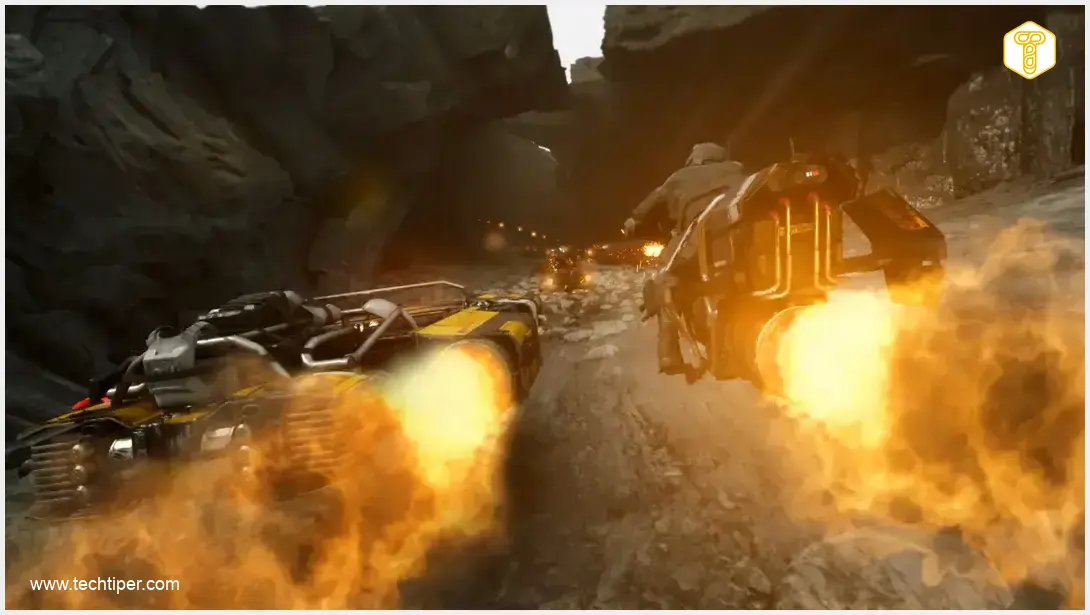
What immediately captivates players is the palpable difference in how each vehicle handles. Scooters and gliders demand sharper braking into corners, while the heavy landspeeder enters turns with significant momentum, only to gracefully “wrap around” the correct racing line at the last possible moment. The moment of perfectly executing an airborne drift, teetering on the edge of control, is unforgettable—a clear sign that this is something truly special. Players consistently praise the exhilarating sense of speed and the thrill of maintaining control just moments before a potential crash.

Races involve 12 vehicles, and all tactics are fair game. The start sequence alone is a masterclass in immersion, with a subtle nod to games like Helldivers II. Before the race begins, players are encouraged to activate enhanced abilities through a quick button sequence. Engaging the R2 trigger to ignite the engines evokes the satisfying sensation of flipping switches in a retro-futuristic spacecraft, a core appeal of Star Wars. This innovative approach to genre blending highlights a new direction for arcade racing.
During a race, constant switching between abilities and booster types keeps players on their toes. It’s impossible to relax when you’re simultaneously steering and managing multiple vehicle controls. Strategic booster management is also critical during high-speed sections. There are two modes: a standard boost that’s safe but short-lived, and a far more effective jet engine. But be warned! Spend even a second too long at maximum throttle, and a spectacular crash is guaranteed. Furthermore, environmental elements interact dynamically with your vehicle: lava accelerates engine overheating, while water, ice, and caves provide cooling effects, reminiscent of the MotorStorm series.
This concept is significantly expanded. Adverse weather conditions can also cause minor and major vehicle malfunctions. Acid corrosion blocks abilities and the jet engine, flames accelerate overheating even faster, and freezing conditions severely impair steering. Frustratingly, at later stages, opponents gain abilities to, for example, shoot acid, even if you’re no longer on planets like Sentinel I, known for such hazards.
The locations themselves are stunning, overflowing with Star Wars magic. Highlights include the lush forests of Lantaana, the desolate deserts of Jakku, and the hauntingly icy landscapes of Ando Prime. Beyond these, races feature regenerating offensive or defensive abilities, akin to the WipEout series, or the option to ram opponents into walls and obstacles, much like in Burnout. The satisfaction is immense, especially when a slight bump results in a delayed, spectacular crash animation moments later.
Each opponent is fully voiced, filling your headphones with threats and taunts throughout the race. When you combine the relentless AI on higher difficulties, a limited number of lives per race, an incredible sense of speed, and the sheer audiovisual polish, STAR WARS: Galactic Racer achieves greatness at its core. And that’s before we even delve into the compelling story campaign, which seamlessly integrates a robust roguelike mode.
The Roguelike Twist
For decades, the single-player campaign structure in racing games—especially those not in an open world—followed a simple pattern: complete challenges sequentially, with increasing difficulty. STAR WARS: Galactic Racer upends this convention by dividing the game into three acts. Fail to win the final race in an act, and you’re sent back to the beginning of that act, to try again until successful. This ensures every victory feels earned and every failure provides a learning opportunity.
Each act is further divided into stages, taking place across 4 to 6 planets from the Star Wars universe. Before every race, players land in a paddock—an interactive hub where you can eavesdrop on rival racers, chat with the legendary Sebulba, or upgrade your vehicle with your trusty mechanic, Hibi.
The necessity of replaying races after a crash-induced loss is just the beginning of this campaign’s “roguelike” nature. The more races you successfully complete, the more permanent abilities you unlock to start future campaign attempts, allowing you to reach the end of an act with a significantly more powerful vehicle. Crucially, you don’t have to win every race. Better finishes are rewarded with higher payouts, enabling more upgrades during each visit to the shop.
Among the permanent rewards are tuning points. These enhance one of your three vehicles, but you can’t simply “max out” your vehicles with them. Stronger temporary stats are purchased with in-game currency earned from races. However, the further you progress in an attempt, the larger your budget for the next run, making it easier to acquire desired upgrades at the start.
Beyond standard races, the campaign offers qualifications and field tests. These are typically time trials, but some challenges involve smashing enemies against the clock, reminiscent of Burnout. Before each start in the galactic league, players can also select a racing style that emphasizes specific driving behaviors. For example, the “Brawler” style rewards smashing opponents with an accelerating impulse, prompting you to seek out abilities and parts in the shop that further facilitate this playstyle.
You can then pair this with a sponsor who rewards enemy crashes, allowing you to invest skill points more heavily into vehicle maneuverability, knowing that speed bonuses will come from your chosen style. Again, the better you meet your sponsor’s requirements, the more bonus credits you’ll have to spend in Hibi’s shop. This innovative gameplay could even influence future racing game design, much like discussions around next-gen console capabilities.
Even the malfunction mechanic is cleverly utilized. If you fail a quick-time event during a malfunction, one of your vehicle’s parts incurs a defect. This can only be repaired at the start of the next planet, at a significant cost. The system also works in reverse: sometimes you’ll have the opportunity to buy powerful parts cheaply, but with a defect. It’s not always wise to be greedy; too many defects can prevent you from reaching the finish line, forcing a restart.
Side bets function similarly. Before each race, the game asks you to wager on your predicted finishing position. You can aim for the leader (risking a large credit loss if you fail) or play it safe by betting on a mid-to-lower-table finish to steadily build your wealth. The stakes are particularly high when Kestar Bool participates; winning against him doubles your wager. However, defeating Bool, especially on the highest difficulty (Ace), is an immense challenge.
Bets, sponsors, races—everything funnels into Hibi’s shop. Each subsequent upgrade and part package is more expensive. However, it’s always wise to spend all your money, as the next shop is typically 4-5 races away.
Occasionally, the game introduces random events. An opponent or shopkeeper might propose a tempting deal. Again, decisions should be made with the goal of surviving as long as possible in your current run. But sometimes, taking a risk for fun pays off. Because of the frequent interactions with various league competitors, the races themselves gain a more personal dimension.
This multi-layered implementation of the roguelike element is what makes every race so electrifying. Beyond position and the furiously addictive gameplay, there are always smaller stakes at play, influencing your entire attempt. As you progress in the galactic league, you can also unlock “favors” that add benefits like an increased number of allowed crashes, cheaper parts and abilities in the shop, or higher earnings from bets. You can equip a maximum of three. Styles and favors upgrade based on the number of events completed, a criterion that also includes unlocking items and abilities available in shops on each visited planet.
The Podracer Bonus: A Taste of Nostalgia
As mentioned earlier regarding the campaign, Sebulba often frequents the paddock. This legend of galactic racing, known from Star Wars: Episode I – The Phantom Menace, becomes a key figure. After completing the first act, you can regularly visit him during your runs to engage in podracer races as “memories.” This includes the iconic Mos Eisley track, where young Anakin Skywalker first showcased his talents.
This separate mini-campaign features a dozen or so races, allowing you to unlock crucial abilities for the shop’s rotation. While an upgraded landspeeder might hit 450-500 km/h, podracers operate at significantly higher speeds, reaching 750-900 km/h. They are incredibly agile but also prone to spectacular crashes. It’s absolute racing ecstasy, even for those who never experienced the original Star Wars: Episode I Racer.
This demonstrates the elegant and thoughtful design of the entire STAR WARS: Galactic Racer campaign. The developers could have taken the easy route, releasing a cheap podracer remake. Instead, British studio Fuse Games delivered a fresh, new game, seasoned with just the right amount of nostalgia. Sebulba’s races are limited to one per run, which heightens the excitement for each attempt. What kind of reward would it be if you could conquer all podracer content in just two hours? None at all.
A Genre-Defining Masterpiece
In my opinion, Fuse Games has completely revolutionized the arcade racing genre by expertly combining numerous proven ideas. Dedicated fans have long clamored for the return of series like Burnout, MotorStorm, and WipEout. Simultaneously, roguelike games have been immensely popular for years. Now, everyone gets a game that brilliantly merges all these desires. This includes online multiplayer, set to function optimally post-launch, and a suite of bonus scenarios for those who find the campaign insufficient.
STAR WARS: Galactic Racer is undoubtedly the racing game of 2026. Unless GTA 6 delivers an unforeseen “wow” factor, STAR WARS: Galactic Racer will also be my personal game of the year. I am confident that no better production of its kind has emerged in the last decade. I eagerly anticipate unlocking every possible secret and achievement within it. Even if you don’t typically play racing games, this title is an absolute must-try. Its incredible speed, unparalleled adrenaline, and unprecedented depth in every aspect of gameplay make it a truly groundbreaking experience.
Source: Original content. Opening photo: STAR WARS: Galactic Racer / Press Materials
Frequently Asked Questions (FAQ)
Unlike traditional racing campaigns, STAR WARS: Galactic Racer divides the game into acts where failing a final race sends you back to the beginning of that act. It integrates permanent upgrades, temporary in-run stats, sponsorships, and side bets, infusing every race with layers of risk and reward that make each playthrough distinct and challenging, much like a classic roguelike. This structure also grants rivals distinct personalities and deepens player engagement by making every decision impactful for the current run.
The game masterfully combines the aggressive vehicular combat and takedown mechanics found in the Burnout series, the dynamic environmental interactions and varied terrain challenges reminiscent of MotorStorm, and the futuristic, high-speed anti-gravity racing feel of WipEout. This fusion creates a multifaceted gameplay experience that caters to fans of various arcade racing subgenres while offering something fresh and cohesive.
Absolutely. While it offers deep mechanics and high difficulty settings for veterans, its intuitive controls, engaging narrative, and layered progression systems make it approachable. The roguelike elements, though initially challenging, provide a rewarding learning curve, allowing players to unlock permanent advantages that ease subsequent attempts. Its overall polish and exhilarating gameplay are designed to captivate even those typically outside the racing genre.
The game boasts a stunning audiovisual presentation that rivals the best titles of the current generation. It delivers an incredible sense of speed, immersive vehicle controls, and detailed, magical Star Wars environments like the forests of Lantaana or the deserts of Jakku. The fully voiced opponents add to the immersion, and the iconic podracer segments are a particular highlight, capturing the essence of the Star Wars universe with breathtaking visual and sound design.
About Post Author
