

Contents
CHERY Puts TIGGO 9 PHEV Battery Through Extreme Saltwater and Impact Tests
How does an electric vehicle battery perform after being submerged in saltwater for 24 hours? What happens when it’s then subjected to a severe impact test? CHERY, a prominent automotive manufacturer, set out to answer these critical questions by putting the battery from its TIGGO 9 PHEV model through a series of rigorous safety evaluations. This initiative, part of the Black Sea Safety Challenge, involved first submerging the heavy battery component, then reinstalling it into the vehicle for further dynamic testing.
The Black Sea Safety Challenge: Unveiling CHERY’s Safety Protocols
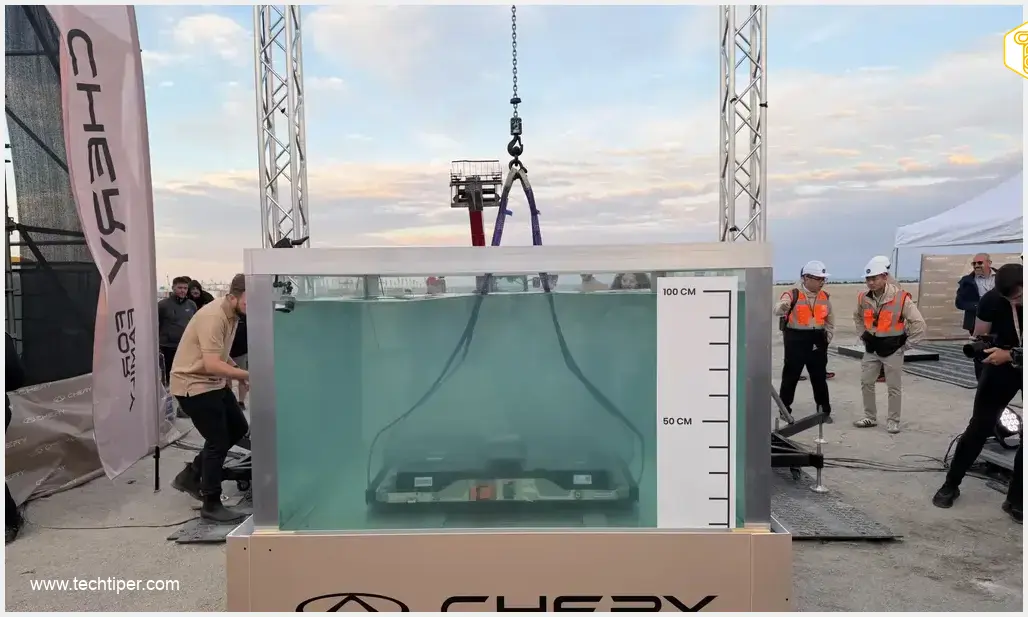
Journalists from 16 European countries gathered for the Black Sea Safety Challenge, an event designed to showcase the safety testing of CHERY’s Super Hybrid (CSH) technology. A highlight of the program was the intensive trial conducted on the traction battery of the TIGGO 9 PHEV. This substantial battery, weighing 228 kilograms (approximately 503 pounds) and boasting a capacity of 34.46 kWh, was carefully removed from the vehicle and prepared for an unprecedented immersion test.
Before its submersion, engineers meticulously inspected the battery, performing a leak test, measuring insulation resistance, and checking its state of charge. This ensured a baseline understanding of its condition prior to the challenging experiment.
24 Hours Under the Sea: The Saltwater Immersion Test
The battery was submerged in water with a salinity of approximately 35 parts per thousand (‰). To put this into perspective, this level of salinity is significantly higher than that found in many major seas, including roughly five times saltier than the Baltic Sea. The upper section of the battery remained approximately one meter (about 3.3 feet) below the water’s surface for a full 24 hours, simulating extreme environmental conditions.
Post-Immersion Analysis: Battery Integrity Maintained
Upon retrieval the following day, the battery underwent another comprehensive inspection. Remarkably, engineers observed no signs of corrosion, bulging, or leaks on the battery casing. A detailed examination of the high-voltage and low-voltage connectors, as well as the safety valve, revealed no traces of water ingress.
Further precise measurements confirmed the battery’s resilience:
- The pressure loss coefficient was measured at 8.067 Pa/min, well below the maximum allowable value of 31 Pa/min for this test.
- The housing resistance remained above 500 MΩ, unequivocally confirming that the high-voltage system’s insulation integrity was preserved.
This phase of testing demonstrated the battery’s robust sealing and structural integrity even after prolonged exposure to highly corrosive saltwater.
Back in the Driver’s Seat: Preparing for Impact
Following the successful immersion test and subsequent analysis, the same battery was reinstalled into the TIGGO 9 PHEV. To the satisfaction of the engineering team, the vehicle started normally, paving the way for the next crucial safety evaluation: an impact test.
This time, the focus shifted from the battery unit itself to the entire vehicle’s performance under stress. The TIGGO 9 PHEV was driven onto a specially prepared ramp and then over a speed bump exceeding 25 centimeters (approximately 10 inches) in height. Moving at around 15 km/h (about 9 mph), the car intentionally struck a metal obstacle beneath its chassis. This trial was designed to assess how both the battery and its protective measures would withstand a significant underbody impact, simulating real-world hazards like road debris or challenging terrain. Advances in battery technology, such as semi-solid-state batteries, continue to push the boundaries of safety and energy density in electric vehicles.

Impact Analysis: Protection Holds Firm
After the impact test, engineers conducted another thorough inspection of the vehicle. Visible damage was noted: the plastic underbody shields had cracked. However, critically, the battery housing itself showed no cracks or structural damage. High-voltage and low-voltage connectors, along with the cooling system lines, were also checked and found to be in good condition. There was no evidence of electrolyte leakage, no uncontrolled thermal events, and no error messages appeared on the dashboard, indicating the battery system remained fully operational and safe.
A key factor in this impressive performance is the battery’s additional layers of protection. CHERY highlights that the steel underbody shield provides a strength of 780 MPa. This robust shield is designed to safeguard the battery from various road hazards, including rocks and other potential impacts, ensuring its longevity and the safety of the vehicle’s occupants.
Beyond the Battery: Comprehensive Safety Features
The Black Sea Safety Challenge also served as a platform for CHERY to showcase other integral safety solutions embedded within its hybrid system. One notable feature is the ability to cut off high-voltage power within a mere two milliseconds. This rapid isolation mechanism is crucial for swiftly de-energizing the battery in the event of a severe collision, further enhancing passenger safety.
Furthermore, CHERY states that its battery is engineered to operate effectively across a wide temperature range, from -35°C to 60°C (-31°F to 140°F). According to the manufacturer, CSH technology has undergone extensive testing in 44 countries, covering diverse road conditions and climatic environments. The battery has successfully passed various other trials, including those involving high temperatures, prolonged water immersion, and penetration protection tests. As electric vehicles become more common, integrating advanced features like EV-specific route planning in platforms like Android Auto will become increasingly important for user experience and range confidence.
CHERY’s Commitment to Safety: A Glimpse into Testing Standards
The Black Sea Safety Challenge marked CHERY’s inaugural event of this nature in Europe. By inviting journalists, the manufacturer aimed to demonstrate not just its finished vehicles but also the stringent safety testing processes that underpin their design and development. While these tests were prepared and conducted by CHERY, providing insights into their internal standards, they were not independent comparative evaluations. Nevertheless, the results effectively illustrated how the TIGGO 9 PHEV’s battery system performed under the challenging conditions established by the manufacturer.
Although the battery successfully passed both the saltwater immersion and impact tests, it’s important to acknowledge that no battery is impervious to every conceivable type of damage. The tests were designed with specific objectives and conducted under controlled conditions by the manufacturer. However, they powerfully showcase CHERY’s approach to battery protection and the high expectations they set for their systems even in demanding environments.
Frequently Asked Questions (FAQ)
The primary purpose was to demonstrate the robust safety and durability of CHERY’s Super Hybrid (CSH) technology, specifically focusing on the TIGGO 9 PHEV’s battery, through extreme real-world simulated tests like saltwater immersion and underbody impact.
The battery was submerged for 24 hours in water with a salinity of approximately 35 parts per thousand. Key findings included no signs of corrosion, bulging, or leaks, and the high-voltage system’s insulation integrity remained intact, with no water ingress into connectors or the safety valve.
After reinstallation, the TIGGO 9 PHEV was driven over a significant speed bump (25 cm) and intentionally hit a metal obstacle under its chassis at approximately 15 km/h. This simulated a severe underbody impact.
While the vehicle’s plastic underbody shields cracked, the battery housing itself showed no cracks or structural damage. High-voltage connections and cooling lines remained intact, with no electrolyte leakage or thermal events, and no error messages appeared.
CHERY emphasizes a steel underbody shield with 780 MPa strength for protection against road hazards, the ability to cut off high-voltage power within two milliseconds for collision safety, and broad operational temperature range (-35°C to 60°C) confirmed by extensive global testing.
Source: CHERY. Opening photo: Jakub Szataniak.
About Post Author
