

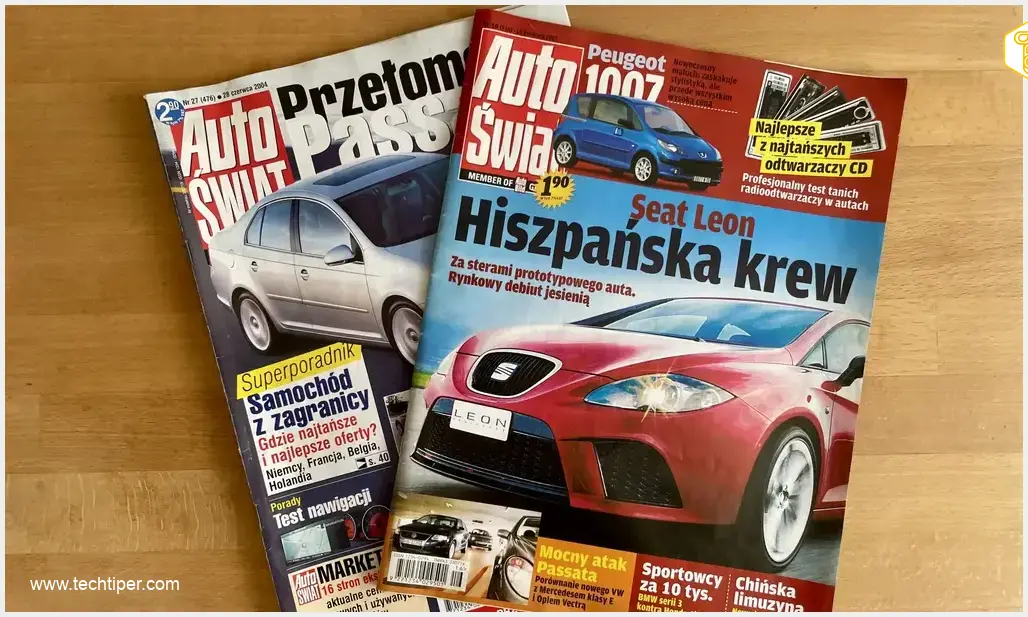
Automotive Evolution: A 20-Year Retrospective on Car Tech and Prices
Modern automotive discussions often revolve around autonomous vehicles and advanced electric powertrains. However, this article will take a different route, focusing on aspects that, while completely outdated today, were considered cutting-edge just two decades ago. Let’s travel back to the early 21st century and explore what truly captivated the automotive industry back then.
The Evolution of In-Car Entertainment: From Basic Radios to Advanced Multimedia
Today, modern cars are equipped with sophisticated multimedia systems offering everything from classic FM radio to Bluetooth music streaming, often integrated with satellite navigation or smartphone mirroring technologies like Apple CarPlay and Android Auto. This level of connectivity and entertainment, which we now take for granted, was merely a futuristic dream just two decades ago.
My recent attic visit provided a fascinating glimpse into this bygone era. While sifting through old boxes, I stumbled upon a collection of automotive magazines, specifically issues of “Auto Świat” (World of Cars) from 2004 and 2005. Two issues stood out: No. 27 (476) from June 28, 2004, and No. 16 (516) from April 18, 2005.
The 2004 issue featured a particularly intriguing comparison test: an original navigation system in a BMW 7 Series against an aftermarket solution from the popular brand Blaupunkt. The article even noted that such systems were only just becoming practical due to the emergence of the first digital maps. This was a significant upgrade from the iconic paper maps that drivers frequently had to consult during pit stops.
Beyond navigation, many new cars sold in the early 2000s didn’t even come with a factory-installed radio. Car buyers often had to purchase this essential piece of equipment separately. In 2005, “Auto Świat” reviewed what they termed the “cheapest” aftermarket radio units available. The term “cheapest” is used loosely here, as these units from popular brands ranged from 400 to 800 Polish Złoty (PLN). To put this into perspective, the national minimum wage in Poland at that time was approximately 849 PLN gross (roughly equivalent to 200-250 USD at the time). These were certainly not inexpensive additions. For a broader international context, imagine these prices representing a significant portion of a month’s entry-level salary in many countries, highlighting their relative expense.
Car Prices Two Decades Ago: What a New Car Cost in 2004
What did it cost to drive a brand-new car off the lot in 2004? Similar to today, prices varied significantly based on the manufacturer and model. While this article focuses on models that later gained substantial popularity in the used car market, we can still gauge the general pricing landscape.
For instance, an Audi A3 hatchback with a 1.6 MPI 102 HP naturally aspirated petrol engine would set you back over 75,000 PLN. The most affordable Opel Astra H, also running on unleaded petrol (1.4 90 HP), was priced at 58,500 PLN. To provide an international context, 75,000 PLN in 2004 would be roughly equivalent to 18,000-20,000 USD at the time (adjusting for exchange rates). This indicates that even entry-level premium and popular compact cars were significant investments.
Considering vehicles from the Volkswagen Group (VAG) stable, let’s look at three iconic models frequently available with the renowned 1.9 TDI diesel engine:
- A basic Seat Leon cost just under 64,000 PLN.
- The Skoda Octavia liftback was approximately 61,500 PLN.
- A three-door Volkswagen Golf hatchback started at a minimum of 69,640 PLN.
These prices reflect a market where certain models were highly sought after for their reliability and fuel efficiency, especially the 1.9 TDI engine, which remains legendary among enthusiasts for its durability.
Other Significant Changes Over the Decades
Changing Automotive and Technological Landscapes
Delving deeper into the 2004 issue revealed another interesting shift: the cost of travel. A photograph on the early pages showed a section of the A2 motorway between Konin and Poznan, which has always been a toll road. Back then, the fee for this segment was 22 PLN, paid in two 11 PLN installments at separate toll plazas. Fast forward to today (as of September 2023, when a new price list for the Autostrada Wielkopolska took effect), the same stretch of road now costs 82 PLN.

This dramatic increase prompts the question: are these sections still as empty as they were shortly after Poland’s entry into the European Union? As a popular saying goes, “I don’t know, but I can guess.” Recently, a friend and I took a day trip beyond Poznan and opted for a free alternative route suggested by Google Maps, sacrificing time instead of money. This illustrates how drivers adapt to rising costs, often using technology to find more economical travel options.
Luxury Features Become Standard: The Case of Air Conditioning
The last page of the magazine featured an advertisement for the popular French brand Citroen. What made it remarkable was that it promoted a special “Freeze” edition, whose key selling point was… air conditioning. Today, this seems almost unbelievable, but two decades ago, air conditioning was far from a standard feature in vehicles. I vividly recall my grandfather replacing his car primarily because his old one lacked this comfort.
Today, a car manufacturer launching a special edition simply to highlight air conditioning would likely be met with ridicule. However, this doesn’t mean every new car from a showroom automatically includes it. Certain budget brands, such as Dacia, still offer base models like the Sandero Essential and Spring Essential without air conditioning. This decision is generally understood, given their focus on affordability.
The Mobile Phone Revolution
Beyond automotive advancements, the magazine also offered a snapshot of early 21st-century technology. An advertisement for the former mobile network Era (which rebranded as T-Mobile in Poland in 2011) showcased a subscription plan: for just 30 PLN, customers received a mere 80 minutes of talk time.
Consider what 30 PLN buys today: typically, unlimited calls, SMS, and MMS messages. The amount of data (GB) might vary by operator, but the overall value has exploded. We not only earn more, but we also get significantly better terms for the same amount of money.
Reflecting on Progress: A Look Back and Forward
Reading through these old automotive magazines was a fascinating experience. While I have some memories of that era, I was quite young, so many details were new to me. Flipping through the pages and seeing the dominant car models of the time brought a smile to my face—not one of derision, but rather appreciation. Many of the powertrains from those vehicles are still fondly remembered today for their robustness and reliability.
Beyond engines (as excellent powerplants are still being developed today), there’s no denying the enormous strides the automotive industry has made. Navigation, once a luxury external unit, is now an integral part of a car’s multimedia interface, or seamlessly available on a smartphone. Radios have long been a factory-standard necessity, offering wireless music playback and a host of other features.
It’s natural to ponder what the automotive landscape will look like in another 20 years, perhaps by 2049. While these predictions largely remain speculative, it’s highly probable that by mid-century, we will witness an even greater revolution in road transport, driven by advancements like autonomous driving and advanced electric vehicle technologies.
Frequently Asked Questions (FAQ)
Twenty years ago, dedicated in-car navigation systems were either a premium factory option or an expensive aftermarket purchase, often costing hundreds of dollars or a significant portion of a monthly salary. Today, navigation is typically integrated into standard multimedia systems, included in a car’s base price, or freely accessible via smartphone apps like Google Maps or Waze, making it virtually free for most drivers.
In the early 2000s, it was common for base model cars to not include a factory radio. Owners would often purchase aftermarket head units from brands like Blaupunkt, Sony, JVC, or Pioneer. These often offered more features than basic factory units but required additional installation and were considered a significant expense, sometimes comparable to a week or two’s wages.
Twenty years ago, air conditioning was a premium feature, often available only in higher trim levels or as a costly add-on, with some “special editions” highlighting its inclusion. Today, it is largely considered a standard feature in most new vehicles globally, though very entry-level or budget models from certain manufacturers might still offer basic trims without it to keep costs down.
Besides infotainment, advancements like electronic stability control (ESC), anti-lock braking systems (ABS), multiple airbags, and advanced driver-assistance systems (ADAS) such as adaptive cruise control, lane-keeping assist, and automatic emergency braking have become widespread or standard. These technologies significantly enhance vehicle safety, fuel efficiency, and overall driving comfort, profoundly changing the driving experience compared to two decades ago.
Source: Original article. Opening photo: Marcin Ziolkowski
About Post Author
