

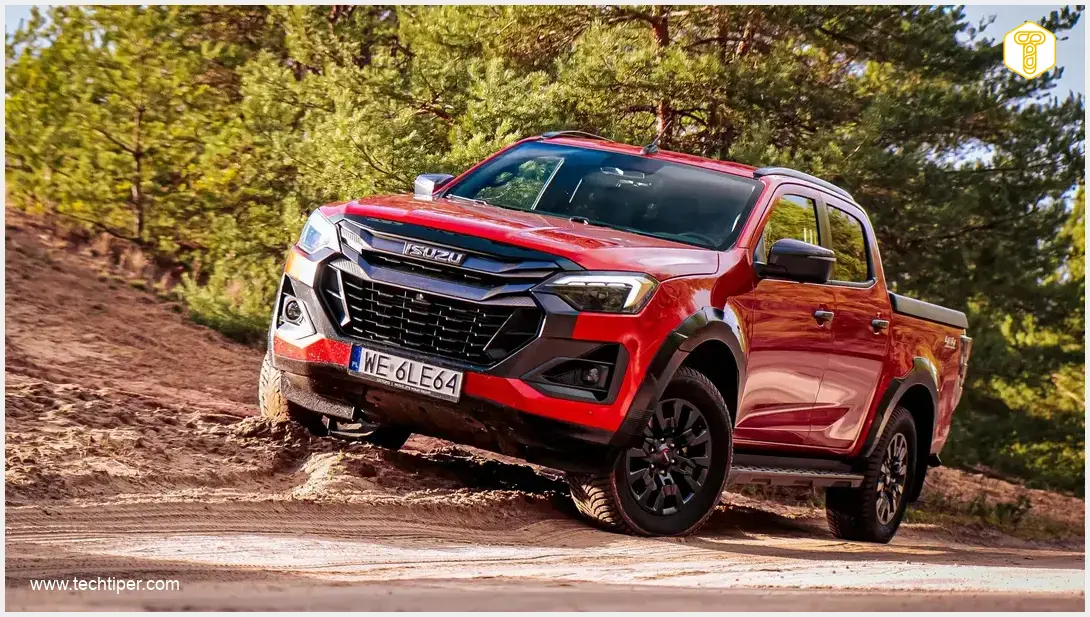
Isuzu D-MAX 2.2 (2026) Review
-
Powertrain (Engine & Gearbox)
-
Driving Dynamics & Performance
-
Fuel Consumption
-
Interior & Comfort
-
Infotainment & Technology
-
Assistance Systems
Refined Workhorse with Significant Powertrain Upgrades
The 2026 Isuzu D-MAX brings crucial upgrades under the hood with a new 2.2-liter engine and an 8-speed automatic gearbox, transforming its driving experience with improved torque, refinement, and fuel efficiency. While maintaining its robust utility and off-road prowess, the addition of a 360-degree camera enhances practicality. It remains a simpler, more affordable, yet highly capable pickup, though cabin insulation and some assistance systems still leave room for improvement.
Advantages
- Significantly improved 2.2-liter engine with more torque and refinement.
- Excellent new 8-speed automatic transmission for smoother shifts.
- Improved fuel efficiency, especially considering testing conditions.
- Retained excellent off-road capability and rugged nature.
- New 360-degree camera system (LSE trim) greatly aids maneuverability.
- Seamless wireless Android Auto and Apple CarPlay integration.
- Practical, durable, and well-built interior with abundant physical controls.
- Competitive pricing for its segment.
Disadvantages
- Still one of the less powerful pickups in its segment.
- Noticeable wind noise and engine vibrations at higher speeds.
- Basic native infotainment system lacking advanced features and language support.
- Intrusive and often inaccurate traffic sign recognition system.
- Mediocre performance from the active lane-keeping assist system.
- Average headlight range and unreliable automatic high beam.
- Short and practically unusable center armrest.
- Minimalist interior lighting.
- Payload slightly decreased due to the larger engine.
Contents
Isuzu D-MAX 2.2 (2026) Review: Under the Hood, a Refined Workhorse
We begin our test of the Isuzu D-MAX, a model that received substantial updates for the 2026 model year. These changes aren’t immediately apparent visually, as they primarily focus on what lies beneath the hood. The most significant revisions include a new engine and gearbox – components that were arguably the weakest links in previous versions. This review will explore how the new powertrain performs and highlight all the differences Isuzu introduced for 2026. Join us for a detailed look.
Pricing and Trim Levels of the Isuzu D-MAX 2.2 (2026)
Isuzu has replaced the previous 1.9-liter engine with a new 2.2-liter unit, making it the sole engine option. Manual transmission variants have also been introduced. The overall configuration remains largely the same, offering three cabin types and four equipment levels. For the 2027 model year, the pricing is approximately as follows (all prices are net, without discounts, and converted from Polish Zloty to USD for international reference, using an approximate exchange rate of 1 PLN = 0.25 USD):
- Single Cab:
- L (2WD, manual transmission): ~$33,000 USD
- L (2WD, automatic transmission): ~$34,500 USD
- L (4WD, manual): ~$36,250 USD
- L (4WD, automatic): ~$37,750 USD
- Extended Cab:
- L (4WD, manual): ~$37,750 USD
- L (4WD, automatic): ~$39,250 USD
- LS (4WD, manual): ~$39,000 USD
- LS (4WD, automatic): ~$40,500 USD
- LSX (4WD, manual): ~$42,250 USD
- LSX (4WD, automatic): ~$43,750 USD
- LSE (4WD, manual): ~$44,000 USD
- LSE (4WD, automatic): ~$45,500 USD
- Double Cab:
- L (4WD, manual): ~$39,000 USD
- L (4WD, automatic): ~$40,500 USD
- LS (4WD, manual): ~$40,250 USD
- LS (4WD, automatic): ~$41,750 USD
- LSX (4WD, manual): ~$43,500 USD
- LSX (4WD, automatic): ~$45,000 USD
- LSE (4WD, manual): ~$45,250 USD
- LSE (4WD, automatic): ~$46,750 USD
Isuzu offers a 5-year warranty on the entire vehicle (up to 100,000 kilometers or approximately 62,000 miles). The paintwork is protected for the same period, while sheet metal perforation comes with a 12-year warranty. The manufacturer continues to promote service packages for the D-MAX, specified by mileage (from 15,000 to 105,000 kilometers), translating to periods of 2 to 5 years.
Estimated Insurance Costs for the Isuzu D-MAX
Based on market data, comprehensive insurance for the D-MAX for a driver with several years of experience can cost approximately $1,000-$1,500 USD annually. For a full package including collision coverage, the cost might be around $4,000-$5,000 USD. These figures can vary significantly based on location, driver history, and chosen coverage.
Additional Costs for the Tested Model
The tested Isuzu D-MAX is the top-tier variant – a Double Cab with an automatic transmission and LSE trim. Its base price of approximately ~$46,750 USD (net) was augmented by the following optional extras:
- Aluminum cargo bed cover (black, tailgate damper, bed liner, tinted windows): ~$2,575 USD
- Metallic paint: ~$875 USD
- Tow hitch: ~$500 USD
The final price for this configuration exceeds ~$50,500 USD (net). It’s worth noting that these figures pertain to the 2027 model year; the 2026 models were marginally less expensive.
Isuzu’s additional equipment primarily focuses on accessories for paint protection, additional side steps, bull bars, and similar items. However, the configurator also includes options such as cornering lights or integration of the cargo bed with central locking.

For an extreme variant, don’t forget to check out the Isuzu D-MAX Arctic Trucks test.
Technical Specifications of the Isuzu D-MAX 2.2 (2026)
The new engine and gearbox represent the most crucial changes in the 2026 Isuzu D-MAX. These updates primarily result in a significant increase in torque (by 40 Nm or approximately 30 lb-ft), which is now available across a wider RPM range. The manufacturer also claims lower fuel consumption. While horsepower remains the same, performance has been marginally improved, though Isuzu does not officially publicize these figures.
The 2.2-liter engine performs notably better on paper compared to its 1.9-liter predecessor. It remains a 4-cylinder diesel unit but now complies with stricter emission standards. Crucially, the gearbox has also seen an upgrade. While still a hydraulic automatic transmission, it now features 8 speeds, up from the previous 6.
Other changes are largely symbolic, with only the most dedicated fans likely noticing minor stylistic differences in various elements. These cosmetic tweaks do not affect the vehicle’s dimensions or off-road capabilities. However, the payload capacity has slightly decreased due to the larger engine (adding approximately 80 kg or 176 lbs), bringing the tested model’s payload to 983 kg (approximately 2,167 lbs), just under the 1-metric-ton mark.
Another notable point is the cargo bed length, which on paper, has grown by a few centimeters, but only for the double cab variant. This might be an oversight in the manufacturer’s materials, as the actual usable space could vary depending on the bed liner and cover.
You can find the full history of the Isuzu D-MAX in previous reviews of this model. It remains a Segment I pickup truck distinguished by its competitive pricing. Key competitors include the Toyota Hilux, Ford Ranger, JAC T8 Pro/T9, Mitsubishi L200, and KG Mobility Musso Grand.
Infotainment System in the Isuzu D-MAX: Simple and Functional
The powertrain changes have not ushered in a revolution in the D-MAX’s software. Since it’s primarily an engine upgrade, significant infotainment system updates were not expected. Consequently, the system still lacks native language support (e.g., Polish), features a very simple interface, and offers average performance. Fortunately, its use is minimized by the abundance of physical buttons throughout the cabin, prioritizing practicality over digital complexity.
The central display measures 8 inches in most trim levels, upgrading to 9 inches in the top-tier variant. The instrument cluster always includes analog gauges. These can be complemented by a 4.3-inch trip computer screen or a more advanced 7-inch digital display (available in LSE and LSX trims).
Central Screen: No Major Changes
As mentioned, there are no significant changes to the Isuzu D-MAX’s infotainment system. It focuses on basic settings and lacks advanced features such as an integrated owner’s manual, voice assistant, or complex multimedia functions. The dashboard displays widgets and various powertrain visualizations, allowing control over central locking and lighting – essentially, the essentials.
The independent climate control panel and physical switches for drivetrain selection remain, designed for convenience in daily use. Minor differences in functionality may be observed in connection with richer equipment regarding assistance systems, which we will discuss later.
Beyond Bluetooth, connectivity options include a Wi-Fi hotspot, though this doesn’t translate to specific application support. Isuzu, therefore, provides only the connectivity necessary for everyday use.
The D-MAX cabin can be equipped with 2, 4, 6, or 8 speakers. The tested, top-tier version naturally features the most comprehensive sound system. The audio quality remains quite good, and perhaps even slightly better due to the engine’s improved refinement, although cabin insulation still leaves room for improvement.
Android Auto and Apple CarPlay: Seamless Smartphone Integration
The Isuzu D-MAX does not feature a built-in navigation system. Instead, it fully embraces wireless Android Auto and Apple CarPlay. Both platforms work very well, seamlessly projecting navigation instructions to the digital instrument cluster. This focus on smartphone integration provides users with their preferred mapping and media apps without redundancy.
Digital Gauges with Analog Needles
Given that the central screen’s settings are not extensive, many options can be found within the digital instrument cluster. Even here, a revolution isn’t to be found.
Three themes are available, complemented by widgets, along with a menu offering various settings, including those for assistance systems. This means some information from the central screen is reiterated here. Again, native language support is absent.
Isuzu D-MAX (2026) Interior: Subtle Differences for the Discerning Eye
The new engine and modified gearbox do not bring any fundamental changes to the Isuzu D-MAX cabin. Therefore, the following sections will serve as a reminder of the general layout and features of the vehicle’s interior. For more in-depth details, you can refer to previous reviews of the D-MAX. The cabin remains simple, dark, and highly practical, designed for utility rather than forced luxury.
The keyless entry system operates straightforwardly: distinct buttons on the front door handles allow for locking and unlocking the vehicle. The Isuzu also recognizes when the key fob moves away from the vehicle, automatically engaging the central locking. However, there is no automatic unlocking feature upon approaching the D-MAX.
For the cargo bed to lock with the central locking, an additional payment is required. Otherwise, you must remember to lock it independently. In the case of the tested vehicle, the hardtop cover itself provides effective security.
Front Row: Classic Pickup Utility
Entering the Isuzu D-MAX is facilitated by side steps and grab handles, making it quite convenient. However, care must be taken to avoid dirtying trousers on the side steps, which are prone to collecting grime. In the tested pickup’s factory configuration, there’s no need for excessive climbing, as the ground clearance remains at a standard level.
The door panel is simple, relatively hard, but features large, easy-to-use buttons. It’s noticeable that only the driver’s window offers automatic control; the other windows require holding the switch until fully open or closed.
Seats: New Upholstery for Familiar Comfort
The first, and arguably most significant, interior change in the D-MAX is the redesigned upholstery on the otherwise familiar seats. The basic structure, shape, and side bolstering remain the same, although the padding feels firmer. Nevertheless, long journeys remain comfortable. For off-road driving, a more contoured seat base would be preferable.
Electric adjustments are still exclusive to the driver’s side (without memory function), offering height adjustment and lumbar support. The passenger can only adjust the backrest recline and fore-aft position. Both front seats are heated with two-level control.
Steering Wheel: Now with Integrated Camera Controls
At first glance, the steering wheel appears identical. It features a somewhat slippery but comfortable rim, which unfortunately is not heated. Two-way adjustment allows for finding a comfortable driving position. The controls are user-friendly, relying on physical buttons with clear differentiation of functions.
A new feature, exclusive to the top LSE trim, is a set of two buttons on the left spoke. These activate the 360-degree camera view. Previously, this spot was simply a blank cover, as the D-MAX only offered a rearview camera. These new buttons are particularly important because users must manually activate the 360-degree view if they need more than just the rearward perspective.
Dashboard: Practicality Remains Unchanged
The dashboard design itself presents no new features, at least in the tested 2026 model year vehicle. Newer 2027 models will see a minor change, as Isuzu will begin installing a driver monitoring system to comply with European Union regulations.
While the black plastic dominating the Isuzu D-MAX dashboard might seem uninspiring, it’s crucial to remember that this is a pickup truck designed for durability and demanding work. The interior confidently conveys this impression, with no creaks or rattles. Furthermore, it boasts numerous practical solutions, including extensive storage compartments, additional cup holders, and more. Isuzu eschews touch-sensitive buttons, so virtually everything is operated via physical switches, knobs, and buttons.
However, the armrest remains a point of contention; it’s too short and, from the perspective of a driver around 1.8 meters (approximately 5 feet 11 inches) tall, is practically unusable. The new transmission does not alter the gear lever, which operates identically to before, including the manual shift mode.
Second Row: Another Round of New Upholstery
Entering the second row of the tested Isuzu is straightforward, though passengers will notice a distinctly smaller opening. Side steps and grab handles continue to be helpful for ingress and egress.
The rear bench seat of the Isuzu D-MAX also features new upholstery, applied to the same frame. This means a bit more eco-leather, though it’s purely a stylistic change. There’s ample space for two adults up to approximately 1.9 meters (6 feet 3 inches) tall, though the almost vertical backrest might require some getting used to.
Naturally, the D-MAX’s second row still offers a suite of practical features, including various hooks and numerous options for seat and backrest configurations. Interested in how other manufacturers handle interior space? Check out our review of the Toyota Corolla Cross GR Sport.
Interior Lighting: Still Minimalist
Isuzu has opted not to install more powerful bulbs in the D-MAX’s two interior ceiling lights, resulting in minimalist illumination. This applies not only to the interior, as even unlocking the central locking externally does not activate the headlights.
Cargo Bed: A New Cover Option
The tested Isuzu D-MAX showcases a third type of cargo bed cover. Previous tests explored a manual roll-top cover and a full hardtop canopy. This time, the press vehicle was equipped with a lift-up cover, which is both convenient and, paradoxically, the least practical option.
In terms of operation, the hydraulically-assisted lift-up cover (opening to 45 degrees) is definitely the most user-friendly. The additional light is also a plus. However, this type of cover limits the bed’s usable height, making it difficult to transport taller items. The cargo area itself lacks any tie-down points.
As always, an optional tow hitch is available; in the tested model’s case, it boasts a towing capacity of 3.5 metric tons (approximately 7,700 pounds).
Driving Impressions of the Isuzu D-MAX 2.2 (2026): A Pickup Remains a Pickup
The new diesel engine and gearbox have slightly increased the Isuzu D-MAX’s curb weight, but this translates into virtually no changes in driving characteristics. It remains a pickup truck designed for work and heavy hauling, so comfort takes a backseat. Nevertheless, driving the tested Isuzu is by no means strenuous.
The steering system remains light and poses no issues during maneuvers in various scenarios. While the turning circle isn’t exceptional (12.5 meters or approximately 41 feet), it’s perfectly acceptable for a vehicle of this size. It’s a pity that the power assistance doesn’t vary with speed, as this would provide better precision at higher velocities.
The traditional suspension, featuring leaf springs at the rear, encourages driving with a loaded bed, as this smooths out the ride. Nevertheless, the Isuzu D-MAX’s suspension handles uneven surfaces well and maintains stability in everyday use, without any unsettling behavior even when unloaded. For a different perspective on vehicle dynamics, you might enjoy reading about driving the new Opel Astra alongside its 64-year-old ancestor.
Driving Dynamics of the Isuzu D-MAX 2.2 (2026): More Than Just Symbolic Improvements
We arrive at the most crucial update. The 1.9-liter engine has been retired in favor of a 2.2-liter successor. Both units produce the same power output (163 horsepower), but the key difference lies in torque, which has increased from 360 Nm to 400 Nm (approximately 265 lb-ft to 295 lb-ft). This is complemented by the new 8-speed automatic transmission. The rest of the drivetrain, including the low-range transfer case and rear differential lock, remains unchanged.
Isuzu does not officially publish acceleration figures for the D-MAX. With the previous model, 0 to 100 km/h (0-62 mph) took around 13 seconds. The tested model, with its new engine, improves this time by almost a full second (to approximately 12 seconds), even in less favorable weather conditions. While still not blistering, it’s entirely acceptable for a pickup truck.
Drivetrain control is managed by a single rotary knob and an additional button. The knob allows selection between rear-wheel drive, four-wheel drive, and low-range four-wheel drive. The Isuzu D-MAX does not offer an automatic 4×4 mode for paved roads. The button activates the rear differential lock.
The off-road capability of the Isuzu D-MAX remains at the same, very respectable level. Naturally, the tested vehicle, equipped with almost road-biased tires, would require additional preparation for serious overlanding or other challenging off-road tasks. However, its factory capabilities allow for confidently tackling muddy terrain without worrying about traction. It is in these conditions that the additional torque is most appreciated.
Overall, the Isuzu D-MAX, in my opinion, has significantly improved its overall eagerness with the new engine. However, I appreciate the 8-speed transmission even more. The previous 6-speed Aisin unit was often sluggish, sometimes hesitant, and limited the potential of the already modestly powered engine. The new automatic is still a hydraulic torque converter type – no dual-clutch or other complex features – and that’s a good thing. Simplicity remains important, but the quality of operation is much better. Gear changes are smoother, and the additional ratios allow for better management of torque. When driving calmly, the truck almost constantly operates within the engine’s peak torque range.
Of course, the revised gearbox still occasionally has slower moments, but this mainly occurs in situations demanding quick acceleration. In such cases, a faster response would be desirable. However, the D-MAX is a pickup truck, not a competitor to the Ford Ranger Raptor, so such situations are theoretically not its primary focus.
The transmission upgrade is undoubtedly a major plus for the refreshed D-MAX, but what about the engine? Here too, I have very few complaints. In every respect, the new engine surpasses its predecessor. It has more zest, operates with greater refinement, and is generally an all-around improvement. Nevertheless, it’s not a revolution, and I wouldn’t mind seeing a bit more horsepower. Dynamics are adequate, and highway cruising is fine, but the Isuzu remains one of the less powerful pickups on the market, excluding some Chinese competitors, though that’s not a strict rule. The D-MAX still requires anticipating maneuvers, especially when loaded.
While the engine’s operating refinement has improved, it certainly cannot be said that the Isuzu’s cabin has become silent. The engine’s operation and vibrations are still clearly audible and felt, but wind noise becomes a more significant issue at higher speeds. It’s simply loud, and in this regard, the D-MAX still has much room for improvement.
Fuel Consumption and Range of the Isuzu D-MAX 2.2 (2026): Also Improved
The engine change did not alter the Isuzu D-MAX’s fuel tank, which still holds 76 liters (approximately 20 US gallons) of diesel fuel. Additionally, there’s a 13-liter (approximately 3.4 US gallons) AdBlue tank and no form of electric assistance requiring a traction battery.
The most advanced fuel-saving feature in the tested Isuzu is the start-stop system. However, it’s well-known that this is primarily designed to meet EU regulations. Fortunately, the engine’s software manages the shutdown intelligently, not forcing it immediately after a long, high-speed journey, for instance.
Achieving a long range in the D-MAX primarily depends on maintaining a consistent speed. The gearbox excels at keeping optimal RPMs, but any aggressive acceleration or revving of the engine instantly causes instantaneous fuel consumption to surge beyond 20 liters/100 km (approximately 11.7 mpg).
The following results were measured at an ambient temperature of approximately 5 degrees Celsius (41 degrees Fahrenheit), accompanied by noticeable crosswinds. Additionally, the cargo bed carried a load of approximately 200 kg (440 lbs). This scenario resulted in the following trip computer readings:
| Speed/Scenario | Fuel Consumption (Liters/100 km) | Average Range (km) |
|---|---|---|
| City | Average: 9 Minimum: 6.8 Maximum: 11.5 |
~840 |
| Suburban driving (~80 km/h / 50 mph) | 6.4 | ~1110 |
| 100 km/h (62 mph) | 7.5 | ~1000 |
| Highway (120 km/h / 75 mph) | 8.5 | ~890 |
| 130 km/h (81 mph) | 9.6 | ~790 |
| Motorway (140 km/h / 87 mph) | 10.4 | ~730 |
So, do these results indicate that the new engine is more fuel-efficient? In a direct comparison, the results are almost identical to my measurements of the older 1.9-liter model. However, it must be acknowledged that the refreshed D-MAX was tested in lower ambient temperatures and gusty winds. Therefore, it can indeed be confirmed that the Isuzu consumes less fuel. While not a drastic improvement, combined with better performance and more refined operation, credit must be given to the manufacturer for an all-around positive change.
Isuzu D-MAX Assistance Systems: More Cameras, Familiar Features
While exploring the assistance systems, we won’t find many new features in the Isuzu D-MAX, but there’s a pleasant surprise at the very end. The manufacturer has expanded the tested vehicle’s equipment to include 360-degree cameras, which are a truly crucial addition to a pickup truck over 5 meters (approximately 16.4 feet) long. The remaining settings are largely unchanged, allowing simple activation/deactivation without additional controls or detailed descriptions.
Isuzu has added new features but unfortunately hasn’t improved aspects like the traffic sign recognition system. This system is quite intrusive, with frequent and unavoidable beeping alerts. Errors in reading signs – for example, from side roads – are common, and I even observed the D-MAX missing an actual speed limit change for my lane.
In contrast, the mirrors remain excellent, offering a vast surface area that provides more than sufficient visibility during maneuvers. They also include blind-spot monitoring and rear cross-traffic alert systems, both of which operate flawlessly.
The Isuzu D-MAX features adaptive cruise control that functions correctly. Occasionally, however, I felt it reacted a bit late to vehicles ahead, necessitating a noticeably stronger braking action. Nevertheless, these were isolated incidents and still within safe operating parameters. The software also tends to smoothly ease off the throttle, maintaining proper fluidity.
Unfortunately, I cannot say the same for the active lane-keeping assist system. Similar to the traffic sign recognition, this feature needs an update, as its performance is mediocre. Line recognition takes a long time, and on curves, the Isuzu sometimes conflicts with the lane departure warning system.
Headlights: Minor Aesthetic Tweaks
More observant individuals will notice subtle changes to the Isuzu D-MAX’s headlights, confined exclusively to the daytime running light design. Similarly, the rear taillight lenses have changed color – and that’s it. Functionally, we’re dealing with the same system, which can be described as adequate. The tested model naturally comes with a full LED setup, while cheaper versions are equipped with halogen bulbs.
The correct light beam provides appropriate width, acceptable brightness, and fill, but the range is average. Isuzu likely anticipates that D-MAX owners will add LED bars and other auxiliary lighting (e.g., as seen on the Arctic Truck variant).
I would advise against using the automatic high beam switching feature, as it occasionally blinded other drivers. It’s worth remembering that the configurator allows for adding an accessory module for the fog lights, which activates a cornering light function.
The most significant new feature in the Isuzu D-MAX – since the introduction of the new engine – is the inclusion of a 360-degree camera system. While available only in the highest trim level, it’s a substantial enhancement. All other variants receive a rearview camera (and rear parking sensors), which is already very helpful on its own. Front parking sensors are available from the LS trim upwards.
Naturally, one cannot expect outstanding image quality, but even the view provided allows for easier maneuvering. My primary critique relates only to the activation of the display. It activates automatically when reverse gear is engaged, but it is not integrated with the parking sensors, which could potentially adjust the view.
Isuzu D-MAX LSE 2.2 (2026) Review: Conclusion and Our Opinion
We conclude our test of the Isuzu D-MAX, which received a new 2.2-liter engine for 2026, resulting in a noticeably improved pickup. It’s not a revolution, but the engine’s increased flexibility coupled with a significantly better-performing gearbox shifts the vehicle’s typically utilitarian character towards greater comfort. The addition of 360-degree cameras further contributes to this. At the same time, Isuzu has retained its rugged nature, off-road capability, and all the qualities we appreciate in a work-focused pickup.
As mentioned, this isn’t a revolution, so the Isuzu should not be directly compared to the Toyota Hilux or Ford Ranger. The D-MAX is more rugged, but also simpler and, of course, more affordable. However, the overall operating refinement (or cabin insulation) and the performance of certain assistance systems still require improvement.
Frequently Asked Questions (FAQ)
The primary improvements in the 2026 Isuzu D-MAX are found under the hood, featuring a new 2.2-liter diesel engine and an 8-speed automatic gearbox. This new powertrain offers increased torque (40 Nm more) across a wider RPM range, improved refinement, and slightly better fuel efficiency and acceleration, while maintaining the vehicle’s established ruggedness. Additionally, the top LSE trim now includes a 360-degree camera system, enhancing maneuverability for this large pickup.
Source: Self-developed content.
Opening photo: Lukasz Pajak
About Post Author
